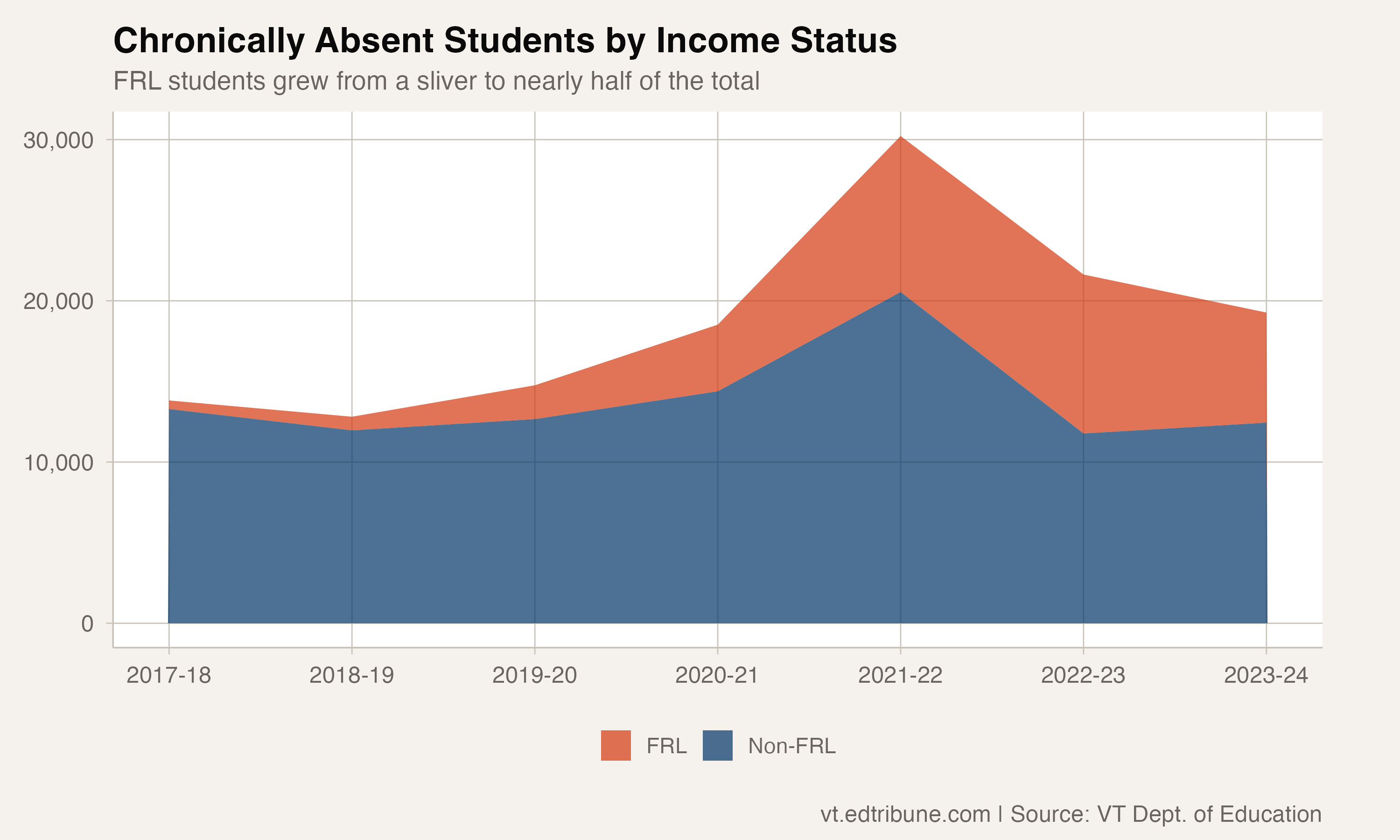
Before the pandemic, poverty was barely visible in Vermont's chronic absenteeism data. In 2017-18, students eligible for free or reduced-price lunch accounted for 534 of the state's 13,821 chronically absent students — 3.9%. Five years later, students eligible for free or reduced-price lunch (FRL) made up 9,861 of 21,631 chronically absent — 45.6%. The share went from a rounding error to nearly half.
That share did not stay there. By 2023-24, the FRL-eligible share of chronic absence had dropped back to 35.4% — a real reduction, but still a nine-fold increase from pre-pandemic levels. The COVID attendance crisis was not experienced equally. It fell disproportionately on students from families with the fewest resources, and the recovery, while real, has been slower for them than for their peers.
The twelve-fold surge
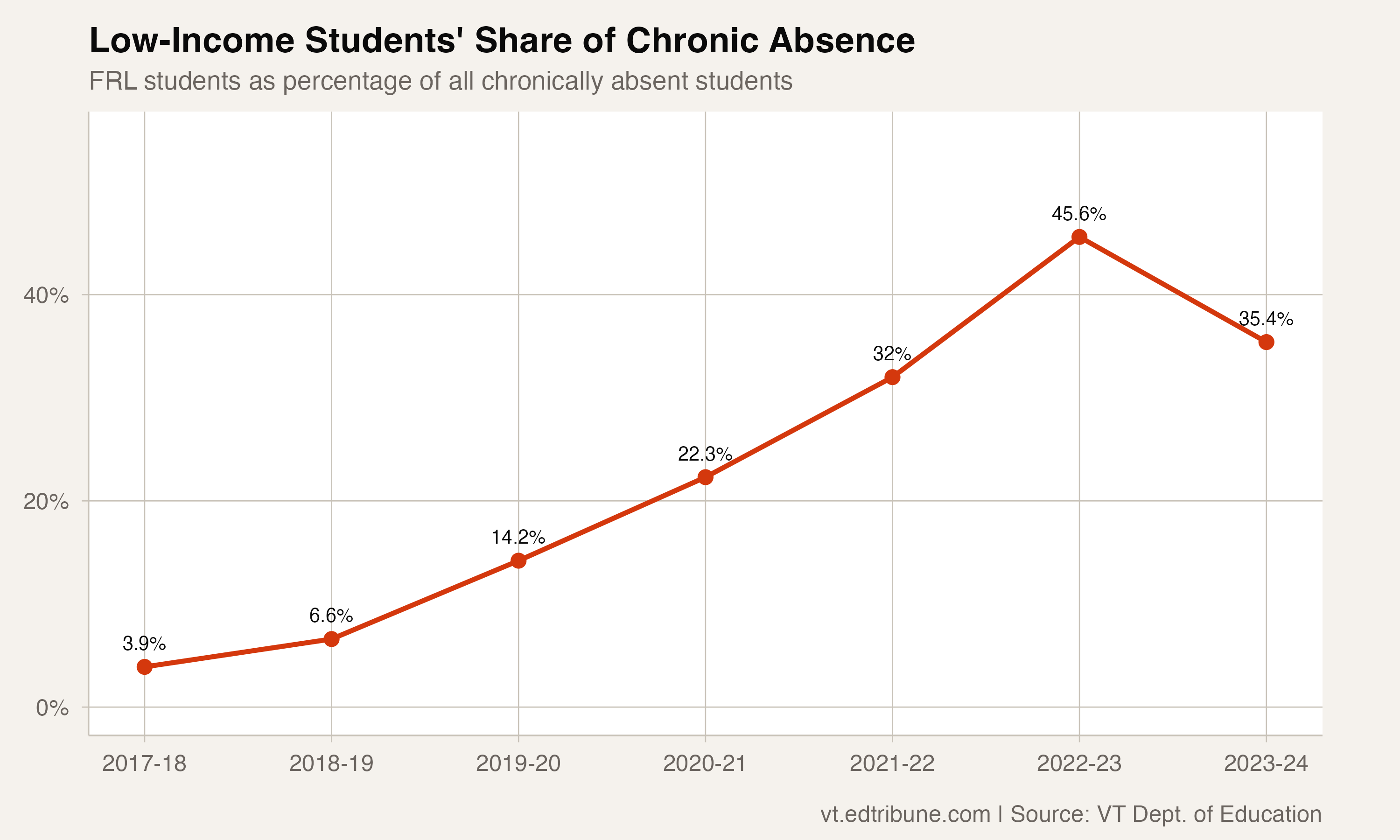
The numbers trace a clear arc. In 2017-18, just 534 students eligible for FRL were chronically absent — 3.9% of the statewide total. That share grew steadily: 6.6% in 2018-19, 14.2% in 2019-20, 22.3% in 2020-21. Then it accelerated. By 2021-22, students eligible for FRL made up 32% of the chronically absent. By 2022-23, they made up 45.6%.
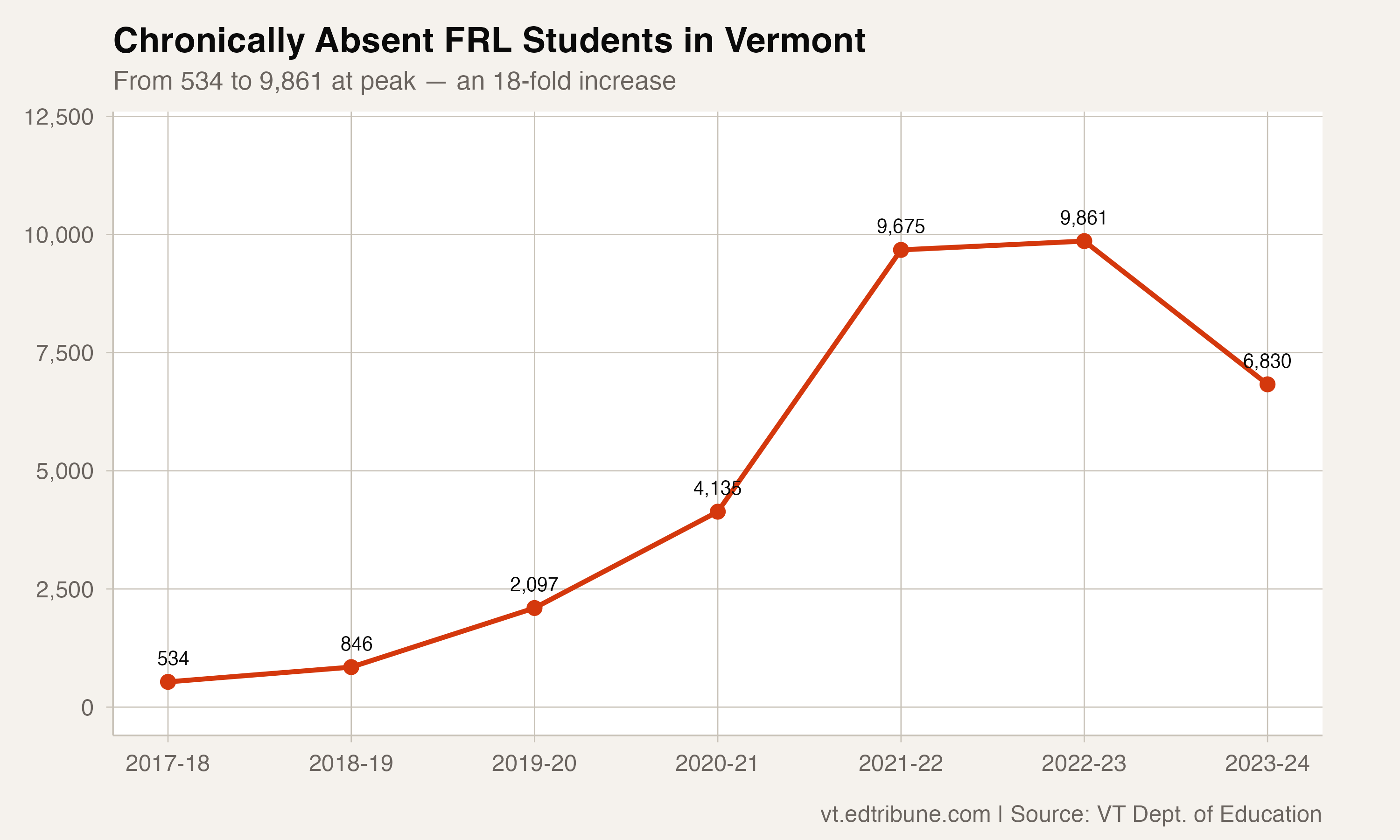
The absolute count tells an even starker story. From 534 chronically absent students eligible for FRL in 2017-18 to 9,861 at the 2022-23 peak — roughly an eighteen-fold increase in five years. In a state with roughly 80,000 students total, that shift reshaped the composition of who was missing school.
A real but uneven recovery
The retreat from the peak has been lopsided. Between 2021-22 and 2023-24, the count of chronically absent students who were not eligible for FRL fell 39.4%. The count of chronically absent students eligible for FRL fell 29.4%. Both are meaningful reductions. But the gap means students eligible for FRL are losing ground relative to their peers even as the overall picture improves.
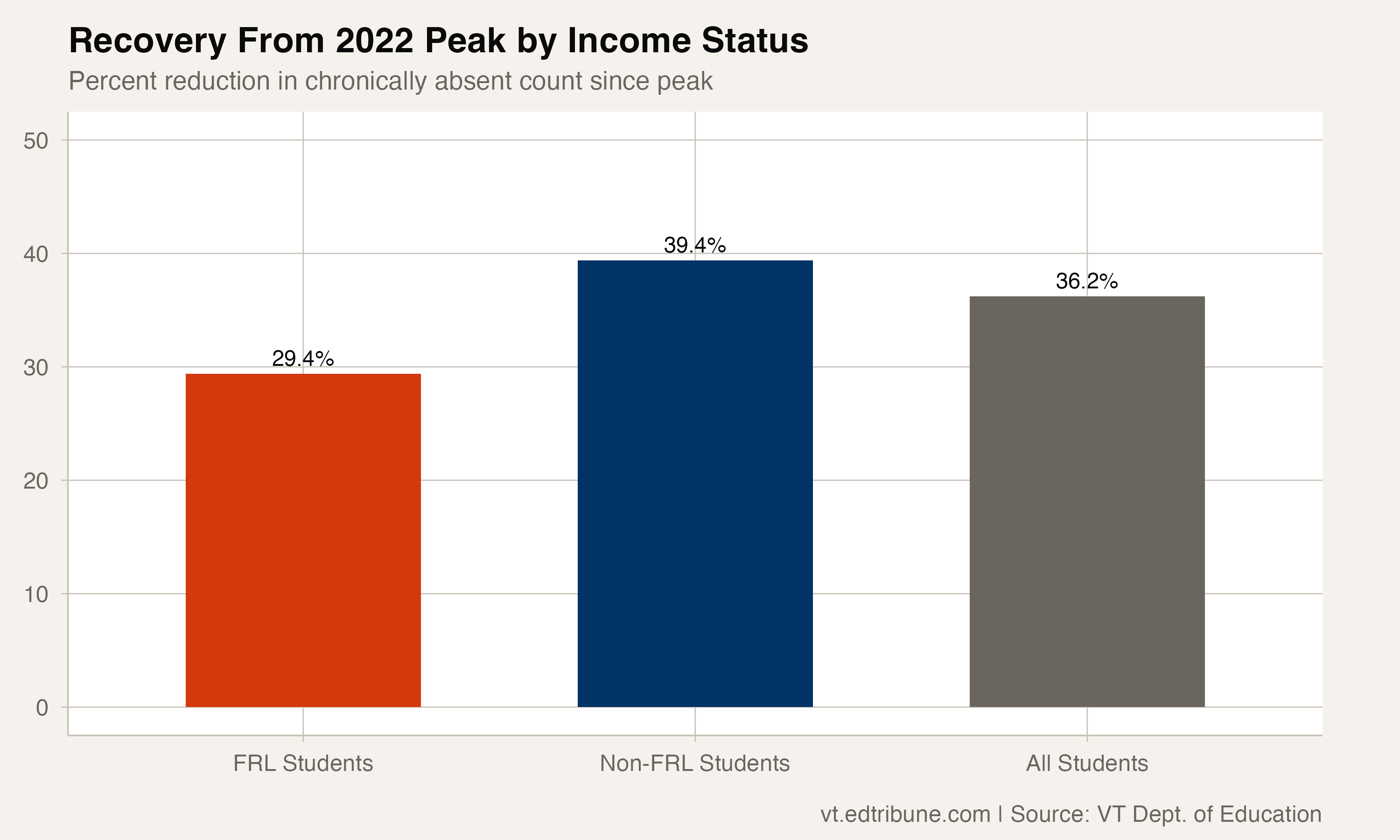
The divergence matters because it compounds. A student who misses 10% of school in one year is more likely to miss 10% the next. When recovery is slower for students from low-income families, the chronic absenteeism gap widens each year, creating a parallel to the academic achievement gaps Vermont already struggles to close.
What the data can and cannot say
One important caveat: Vermont's FRL data sits inside a broader national reporting shift. Many states have moved from traditional free and reduced-price lunch eligibility to direct certification, including the Community Eligibility Provision (CEP), which allows entire schools or districts to certify all enrolled students as eligible. This can inflate FRL counts without a change in underlying family income.
The Vermont trend is still directionally meaningful. The FRL share of chronic absence grew steadily before CEP adoption accelerated, and the recovery gap between FRL-eligible and non-FRL-eligible students exists within the same reporting framework on each side of the comparison. Even if the absolute levels are influenced by CEP, the relative trajectory between groups is informative.
Vermont's funding formula raises the stakes. Under the current system and the incoming Act 73 formula, schools receive weighted funding for students who are economically disadvantaged. Act 73 sets that weight at an additional 102% per student, or roughly $15,334 on top of the $15,033 base. That investment is predicated on students being present to receive the services it funds. When 35% of chronically absent students are the ones generating the highest per-pupil weights, the return on that investment is diminished before it begins.
Where the money goes
Vermont's chronic absenteeism data does not include racial or ethnic breakdowns at the state level. FRL eligibility is the clearest equity lens the dataset offers, and it reveals a COVID-era shift that has only partially unwound.
Each year of elevated chronic absence represents instructional time not received, social connections not formed, and intervention costs incurred. For students from low-income families, those costs compound against existing disadvantages. The 35% share means that more than a third of the state's attendance problem is concentrated among the students generating the highest per-pupil funding weights.
Vermont's UVM "Every Day Counts" pilot, school-healthcare partnerships, and proposed truancy policy overhauls are designed for the statewide problem. The recovery gap suggests they will need to reach families with the fewest resources specifically — not just students broadly — to close the equity gap that the pandemic opened.
Detailed code that reproduces the analysis and figures in this article is available exclusively to EdTribune subscribers.
Discussion
Sign in to join the discussion.
Loading comments...