Winooski↗ET is a one-square-mile city entirely surrounded by Burlington, home to about 7,300 people and a single school district. It is Vermont's most racially diverse community: 57% of students are people of color and 33% receive multilingual services. In 2022-23, the district was heading in the right direction. Its chronic absenteeism rate had fallen from 38.2% to 29.2%. Then something broke.
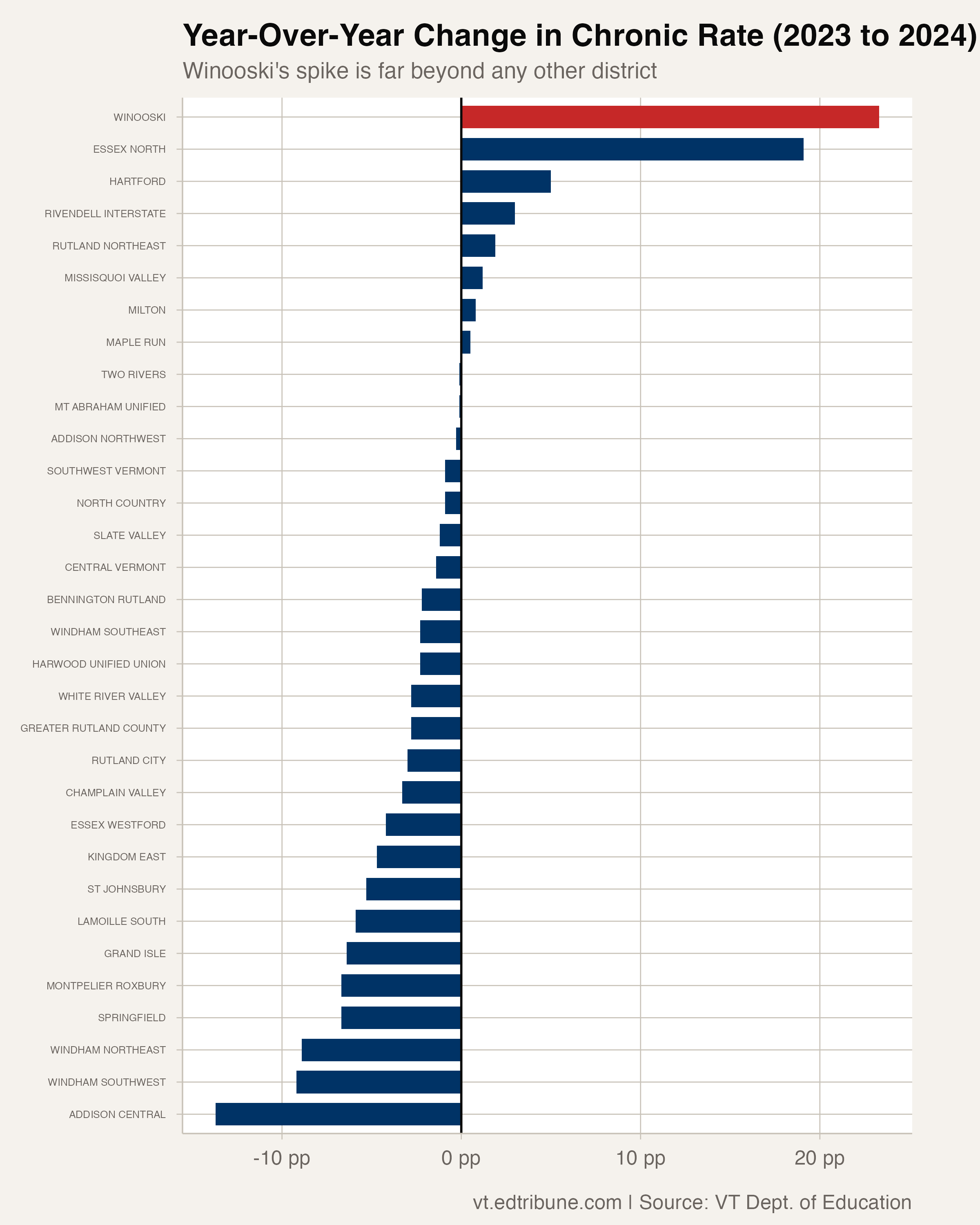
In 2023-24, Winooski's chronic rate surged to 52.5% — a 23.3 percentage point increase that is, by a wide margin, the largest one-year spike of any district in Vermont. Of 770 enrolled students, 404 missed at least 10% of school. Winooski is now the only district in the state whose chronic rate is higher than it was at the 2021-22 pandemic peak.
The numbers in context
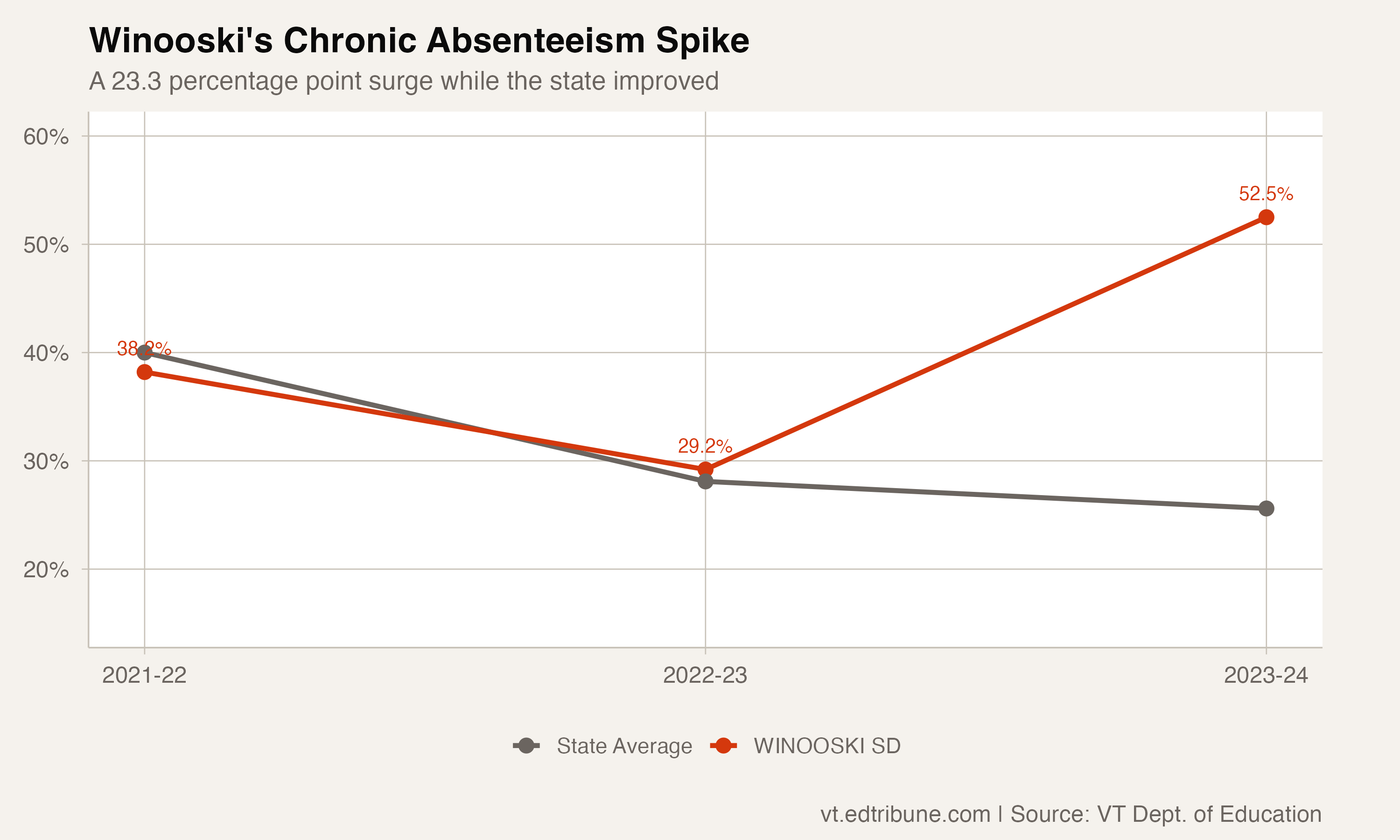
While Vermont as a whole improved from 26.9% to 24.3% between 2022-23 and 2023-24, Winooski moved in the opposite direction by a factor that defies normal year-over-year variation. The next-largest increase in the state was Hartford SD↗ET's 5.0 percentage point rise. Winooski's jump was nearly five times that.
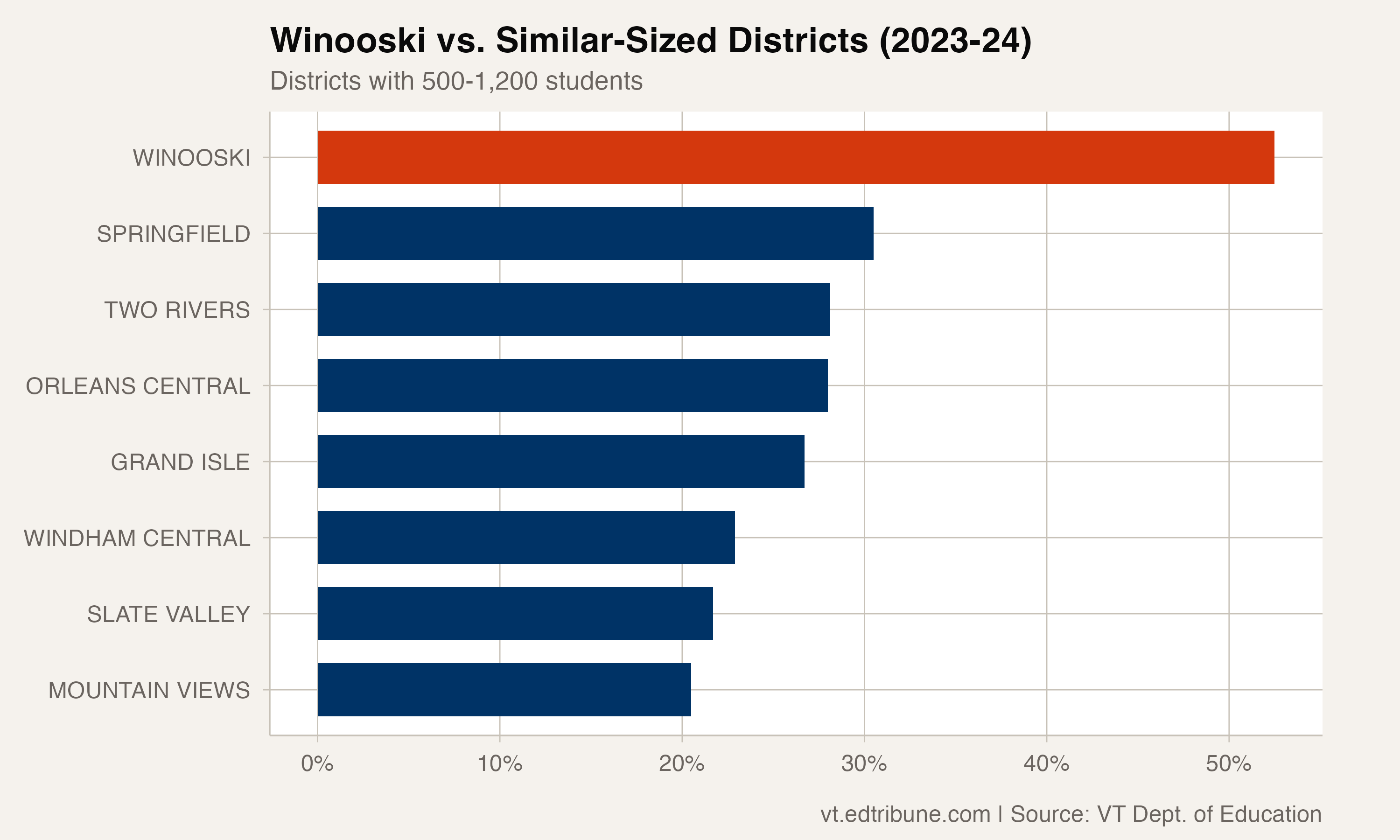
Among districts of similar size — 500 to 1,200 students — Winooski's rate is an outlier by roughly 20 points. Springfield SD↗ET, with 1,201 students, sits at 30.5%. Slate Valley↗ET, with 1,215, is at 21.7%. Winooski, with 770, is at 52.5%.
What happened in 2023-24
The data alone cannot prove causation, but the timeline aligns with a period of intensifying federal immigration enforcement that directly affected Winooski's community. Teachers in the district documented student anxiety about ICE. The district's superintendent was detained by federal authorities. Families with precarious immigration status faced a choice between visibility and safety.
In February 2025, Winooski became the first district in Vermont to pass a "sanctuary school" policy by a 4-0 board vote, formally committing to protect student information from federal agencies and to not allow immigration enforcement activities on school grounds. The Vermont Agency of Education issued a statement supporting the district.
The sanctuary policy postdates the 2023-24 attendance data by several months. It was a response to conditions that were already affecting families — conditions the chronic absenteeism data now quantifies.
The count tells the human story
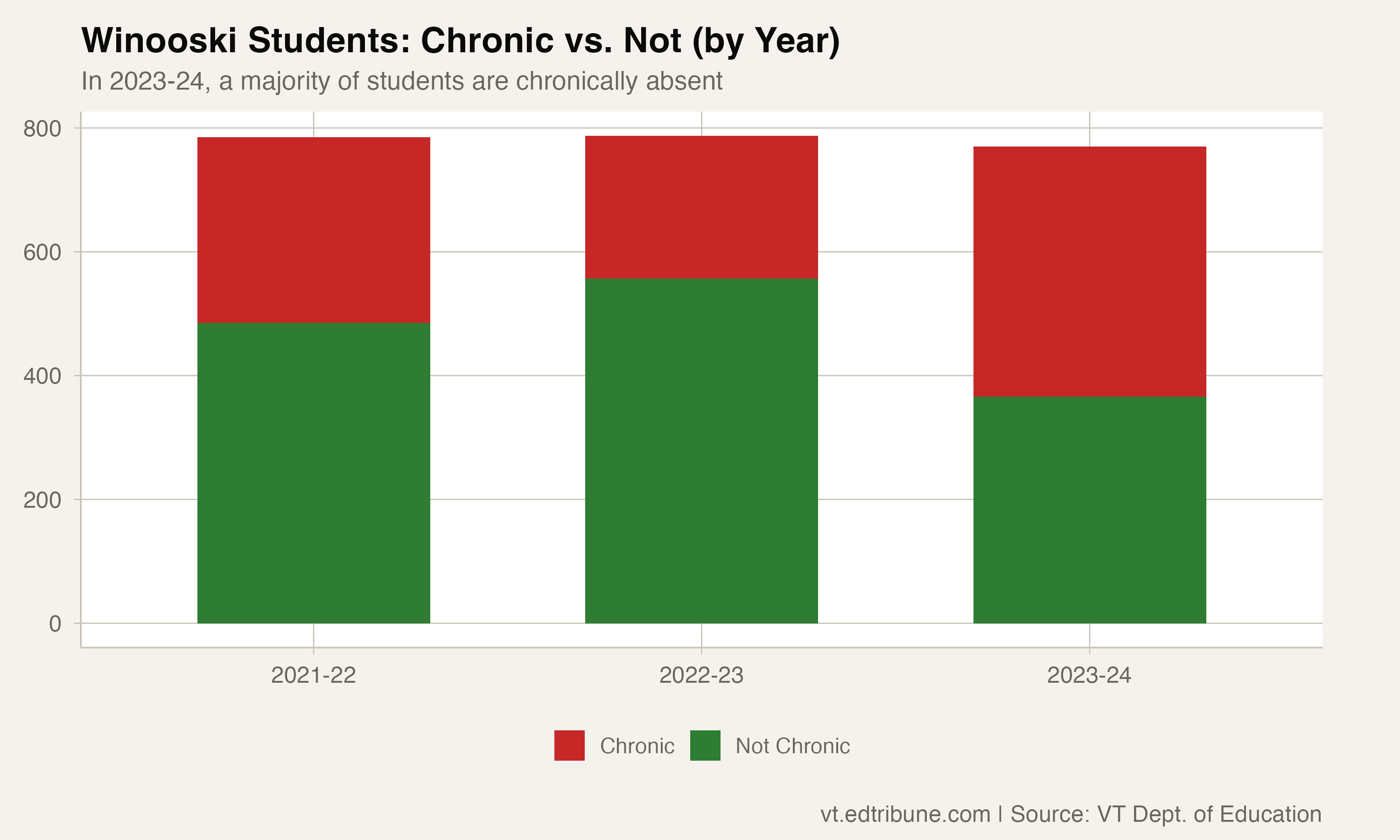
In 2022-23, 230 of 787 Winooski students were chronically absent. In 2023-24, that number nearly doubled to 404 of 770 — an increase of 174 students in a district that shrank by 17. The swing means that roughly 190 students who were attending regularly one year crossed the chronic threshold the next.
In a district this small, 190 students is not a statistical abstraction. That represents a shift in which specific children show up at specific schools. It means teachers notice. It means the cafeteria is emptier. It means the attendance phone calls stack up.
The missing dimension
Vermont's chronic absenteeism data does not include race or ethnicity breakdowns. The state reports by gender, income status, special education, and English learner status, but not by the demographic dimension most relevant to Winooski's story. Whether the spike concentrated among immigrant families, among specific language communities, or spread broadly across the district cannot be answered with public data.
Statewide, LEP students saw only an 8.5% reduction in chronic absence from the 2022 peak to 2024, compared to 36.2% for the overall student body. Winooski's LEP population is large enough that this statewide pattern likely plays a role locally.
What comes next
Winooski's 2024-25 data will be the first test of whether the sanctuary policy has begun to reverse the spike. The policy was adopted in February 2025, midway through the school year. A drop would not prove causation. But a second year above 50% would mean the barriers in Vermont's most diverse district have shifted from episodic to structural, and that the sanctuary policy alone is not enough.
Detailed code that reproduces the analysis and figures in this article is available exclusively to EdTribune subscribers.
Discussion
Sign in to join the discussion.
Loading comments...