In a state where 37 supervisory districts serve fewer than 80,000 students, Vermont's Agency of Education can track chronic absenteeism with unusual precision. What the data shows is not reassuring. One in four students missed at least 10% of school in 2023-24. That is down from a 2021-22 peak when the number was closer to two in five. But the pace of improvement collapsed in the second year, and the state's own director of safe and healthy schools told VTDigger the progress is "not nearly at a rate that is meaningful."
Seven years of data, one pattern
Vermont's chronic absenteeism rate stood at 15.1% in 2018-19, the last full pre-pandemic year. It climbed to 17.7% when COVID first disrupted schools, then accelerated — 23.5% in 2020-21, 37.4% in 2021-22. That peak year, 30,223 students were chronically absent out of 80,757 enrolled. More than a third of the state's student body.
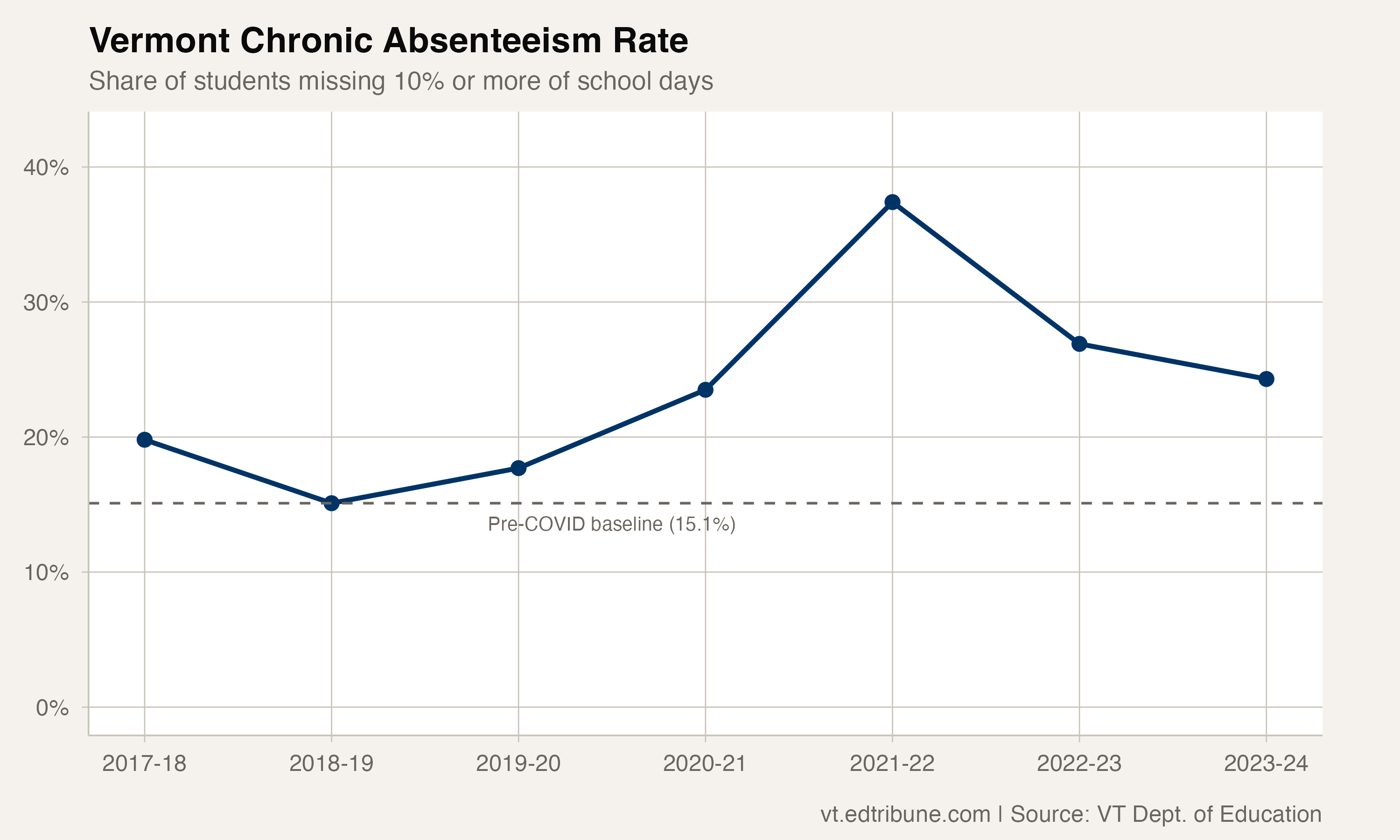
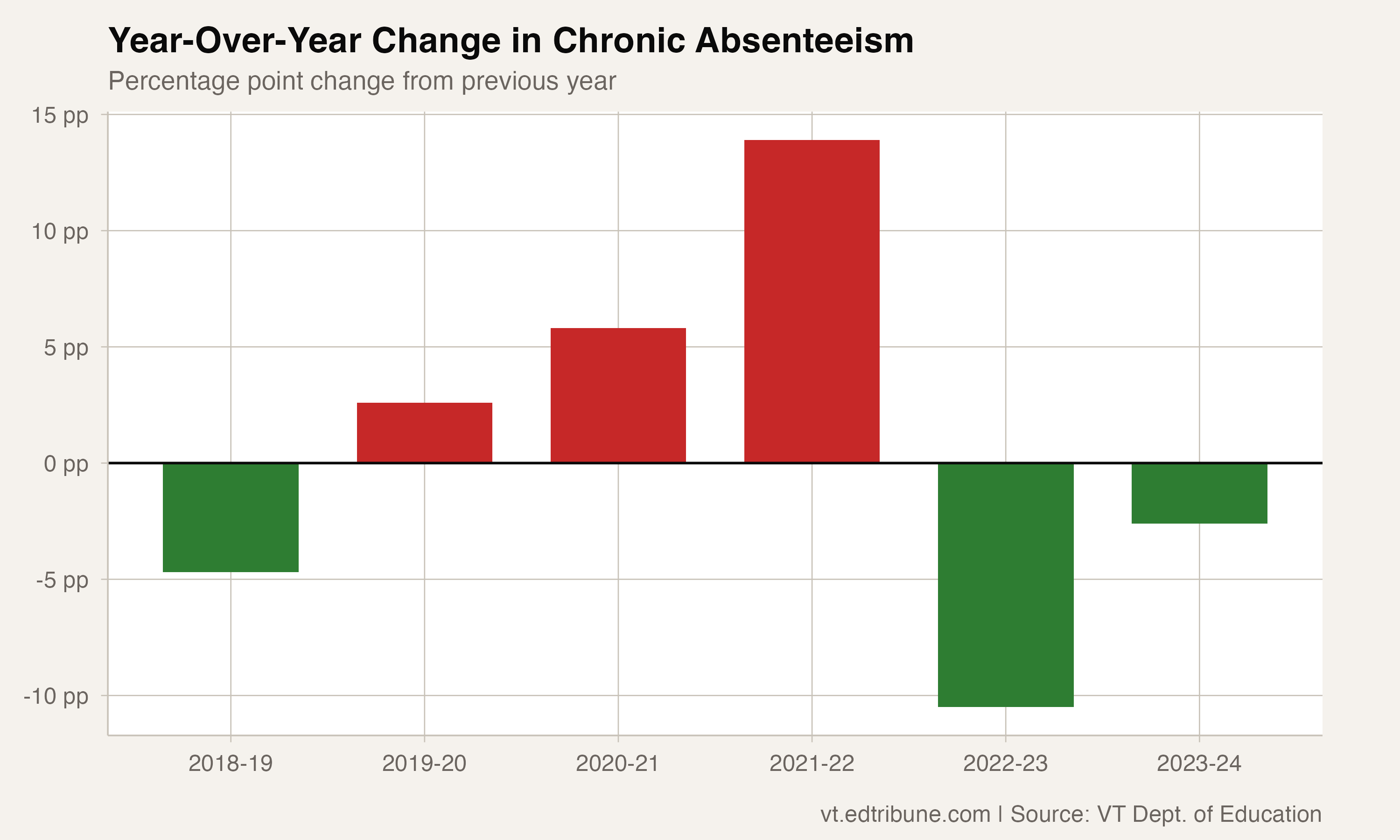
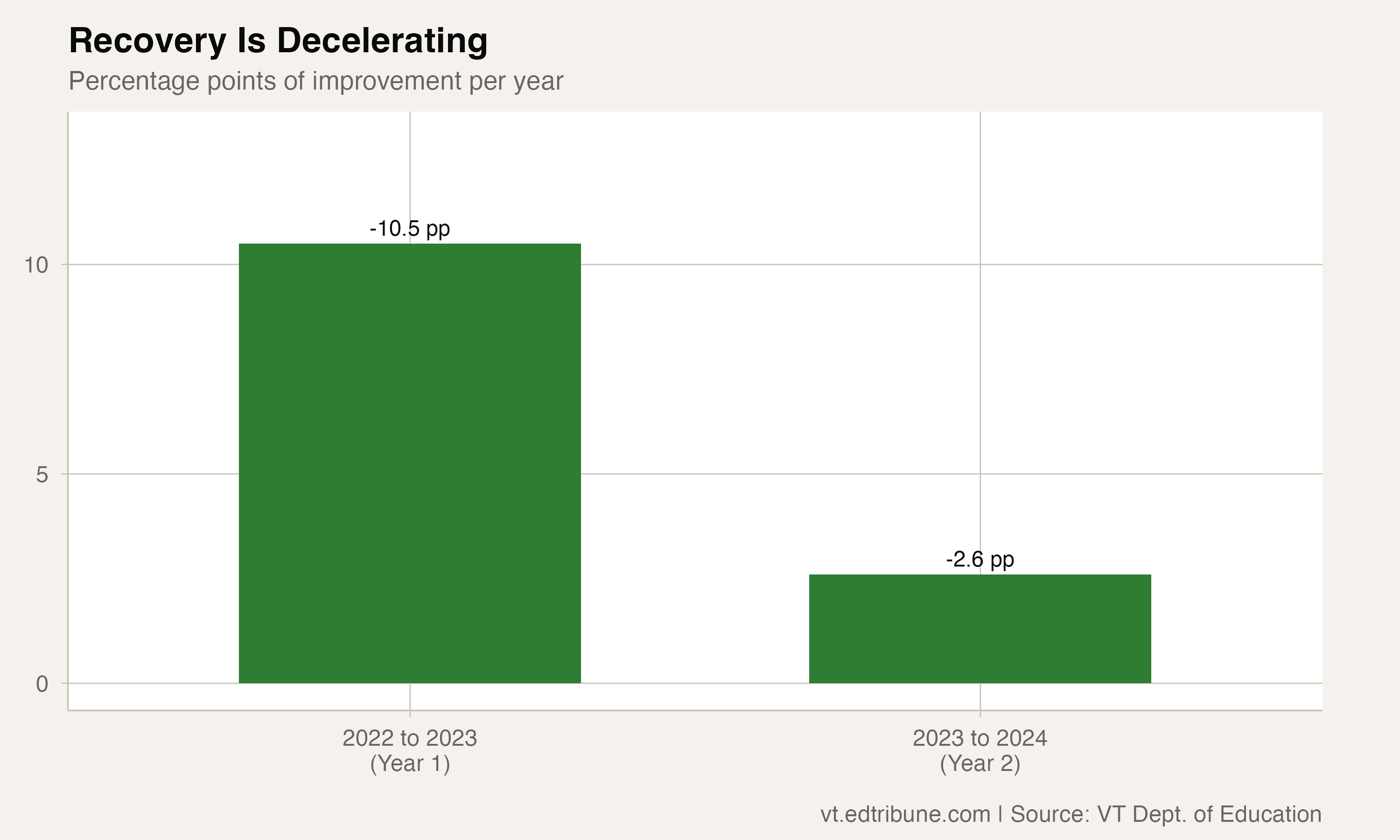
Two years of recovery brought the rate down to 24.3% by 2023-24. But the trajectory tells a troubling story. The first year of recovery, 2022-23, delivered a 10.5 percentage point drop. The second year managed 2.6 points. A four-fold deceleration.
The state has recovered 58.7% of the gap between its pre-COVID baseline and its pandemic peak. At the 2023-24 rate of improvement, reaching the pre-COVID 15.1% would take another three to four years. That assumes the current pace holds, which the deceleration pattern makes unlikely.
The count behind the rate
Rates can abstract away the human scale. In 2023-24, 19,273 Vermont students were chronically absent. Before the pandemic, that number was 12,811. The difference — 6,462 students still on the wrong side of the 10% threshold — is roughly the enrollment of 10 to 12 Vermont school buildings.
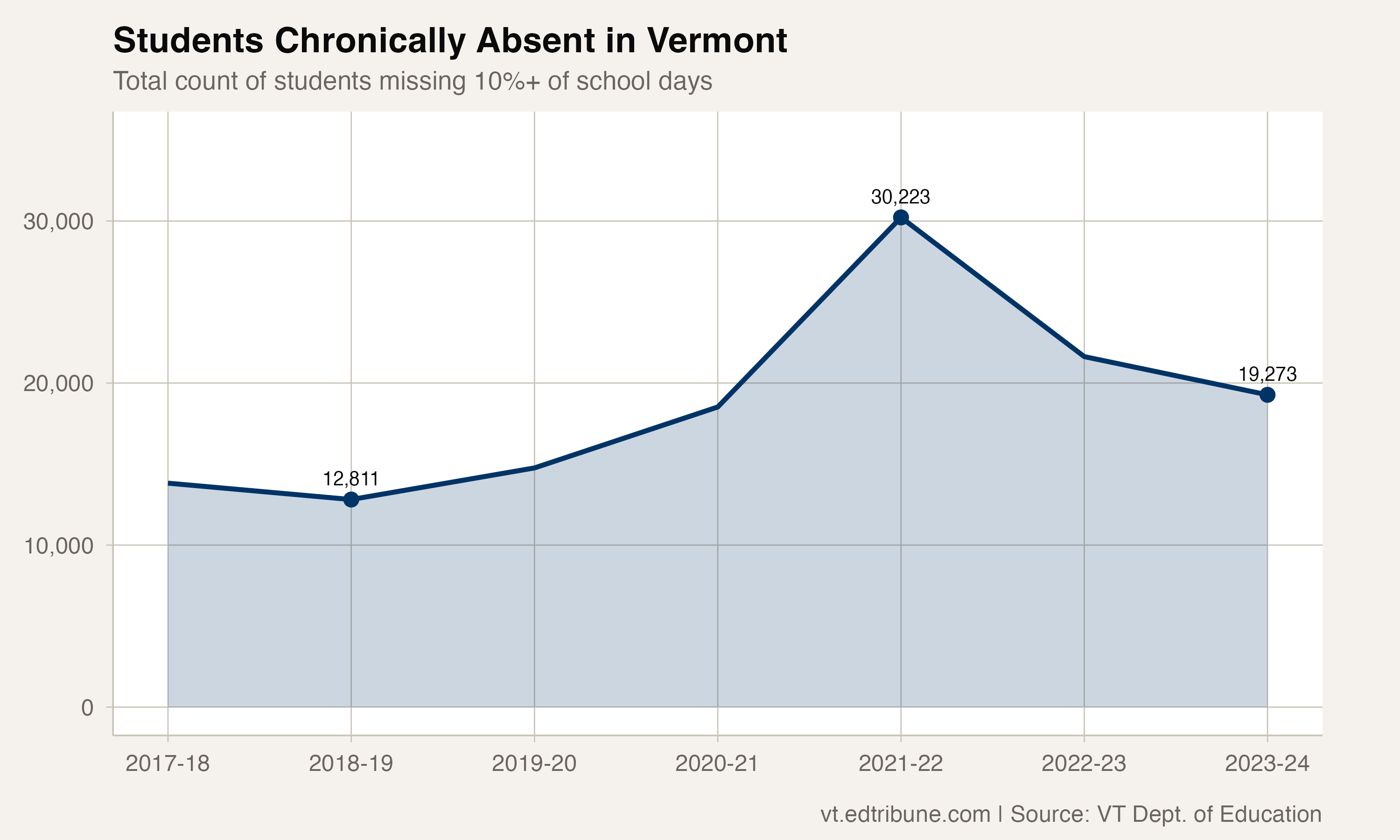
At the peak in 2021-22, the number hit 30,223. The subsequent recovery cut roughly 11,000 students from the chronically absent count. But removing 11,000 students from chronic absence while still having 6,400 more than pre-COVID means the state eliminated the easiest cases. What remains is likely more entrenched.
District variation is enormous
Vermont's 37 districts with reliable rate data in 2023-24 span a range that would be striking in a state ten times its size. Two districts — Rutland City SD and Winooski SD — have chronic rates above 50%. A majority of their students are chronically absent. At the other extreme, Champlain Valley SD has driven its rate down to 9.9%, less than half the state average.
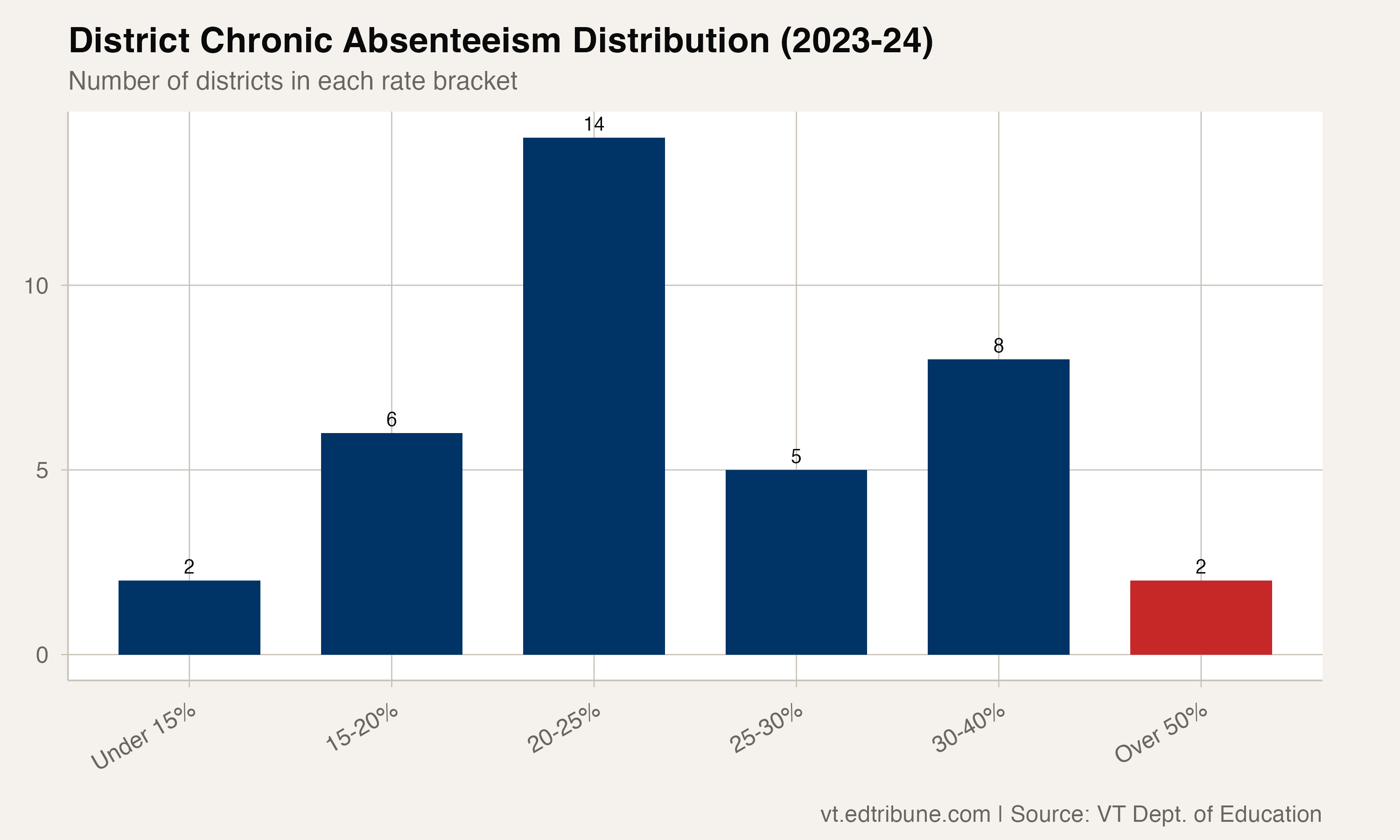
Ten districts sit above 30%. Twenty-one fall below the state average. The distribution is not bimodal or random — it correlates, as it does nationally, with poverty, community health, and whether a district has invested in attendance infrastructure.
What makes Vermont different
Unlike most states, Vermont funds schools based on Average Daily Membership, not Average Daily Attendance. Districts do not lose per-pupil funding when students miss school. The fiscal incentive to pursue attendance is indirect, flowing through academic outcomes and the costs of intervention rather than immediate budget impact.
Vermont is also implementing a new foundation funding formula under Act 73, set to take effect in 2028-29. The formula provides $15,033 per student with a 102% weight for economically disadvantaged students — an additional $15,334 per qualifying student. For districts where chronic absenteeism concentrates among low-income families, that investment is partly unrealized each day students are absent.
In January 2026, the Agency of Education proposed statutory changes to overhaul truancy and absenteeism policies, creating consistent statewide definitions and reporting standards. The University of Vermont's "Every Day Counts" initiative has piloted school-healthcare partnerships in four schools.
The math ahead
The 2023 Youth Risk Behavior Survey found one-third of Vermont high school students struggle with poor mental health, with female and LGBTQ+ students reporting significantly higher rates. For students experiencing homelessness, chronic absenteeism rates hover around 60%. These are not conditions that a truancy policy can resolve.
The first year of recovery captured students whose absences were more situational than structural, the ones who needed a push back to normal routines. The second year's deceleration suggests the remaining 24.3% are harder cases: students whose barriers are medical, economic, or psychological.
Vermont has one advantage most states do not. In a system of 37 supervisory districts serving 80,000 students, a superintendent can know which families are struggling before the quarterly data report arrives. Champlain Valley's 9.9% rate suggests that advantage is real. But Rutland City and Winooski, where majorities of students are chronically absent, suggest it is not sufficient on its own.
Detailed code that reproduces the analysis and figures in this article is available exclusively to EdTribune subscribers.
Discussion
Sign in to join the discussion.
Loading comments...