In a state where one in four students is chronically absent, Champlain Valley SD↗ET has driven its rate to under one in ten. The state's largest district — 4,150 students spread across Hinesburg, Charlotte, Shelburne, St. George, and Williston — recorded a 9.9% chronic absenteeism rate in 2023-24. Two years earlier, it was 21.3%.
That kind of reduction does not happen by accident. It does not happen because of demographics alone. And it raises a question that matters for every district in Vermont performing worse: what did Champlain Valley do?
The numbers
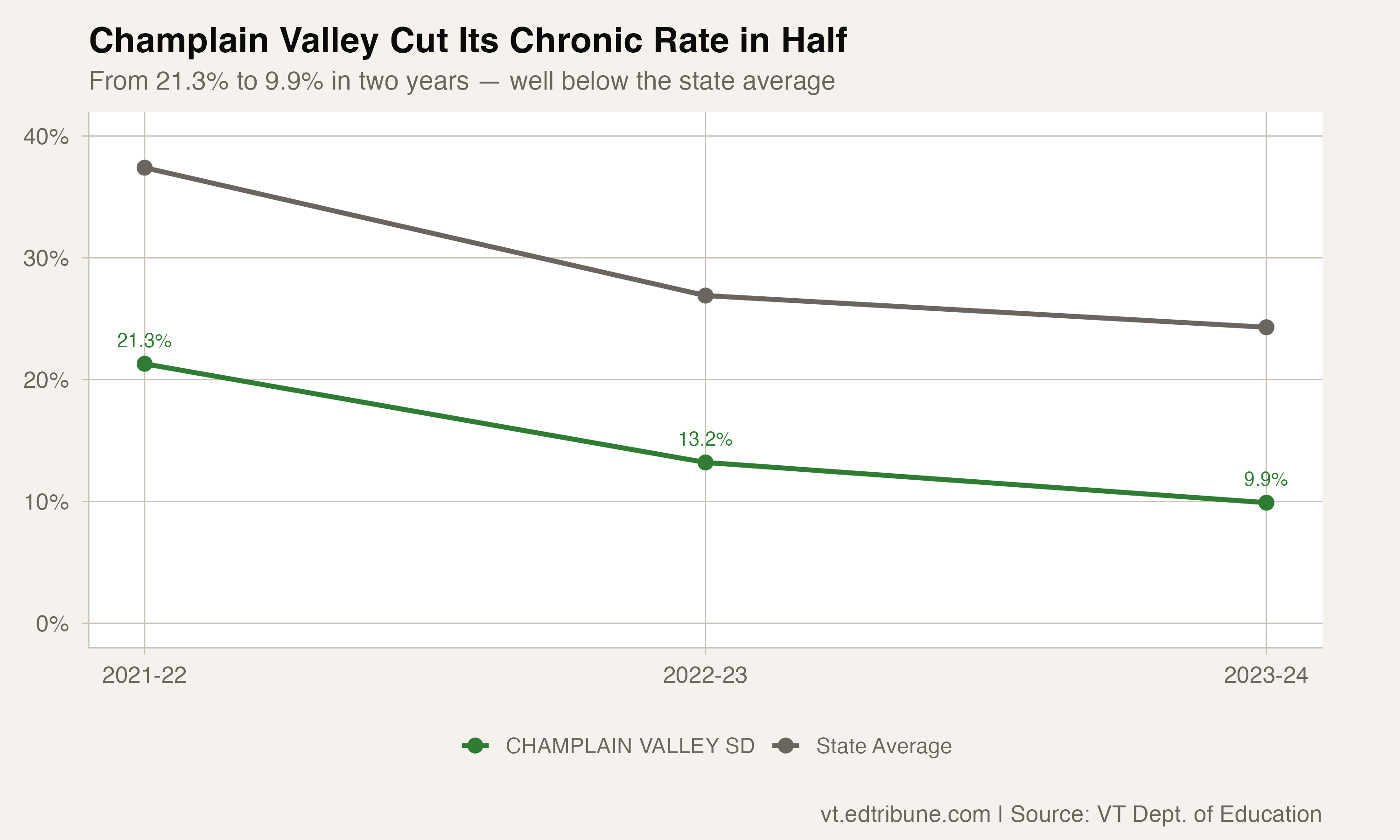
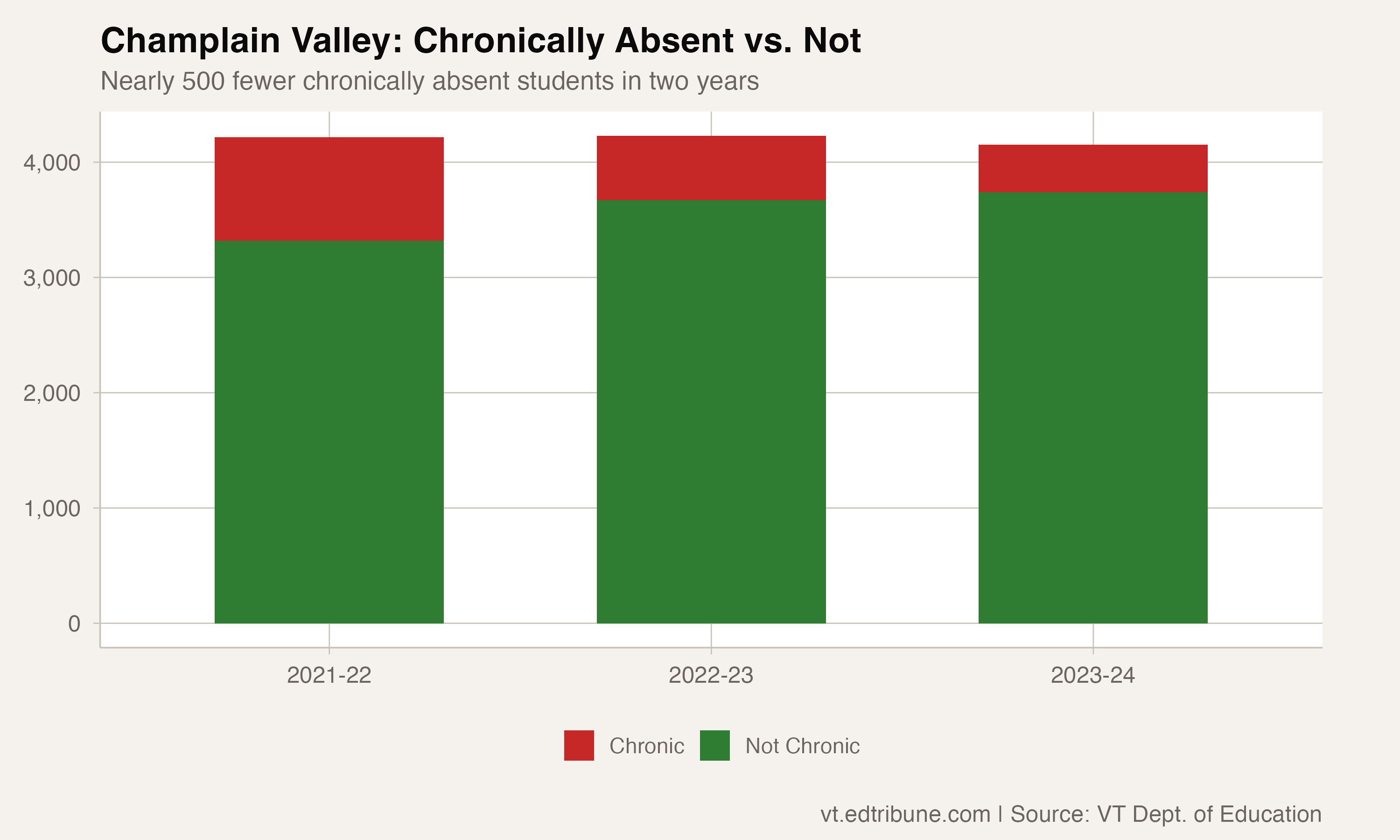
Champlain Valley's chronic rate in 2021-22 was 21.3% — close to the state average at the time. That meant 897 students missing at least 10% of school days. By 2022-23, the number dropped to 557 (13.2%). By 2023-24, it fell to 410 (9.9%). The district shed 487 students from its chronically absent count in two years, a 54% reduction, while its total enrollment barely changed.
The 9.9% rate puts Champlain Valley 14.4 percentage points below the state average and nearly six times below Rutland City↗ET's 56.7%. It is the lowest rate of any district in Vermont.
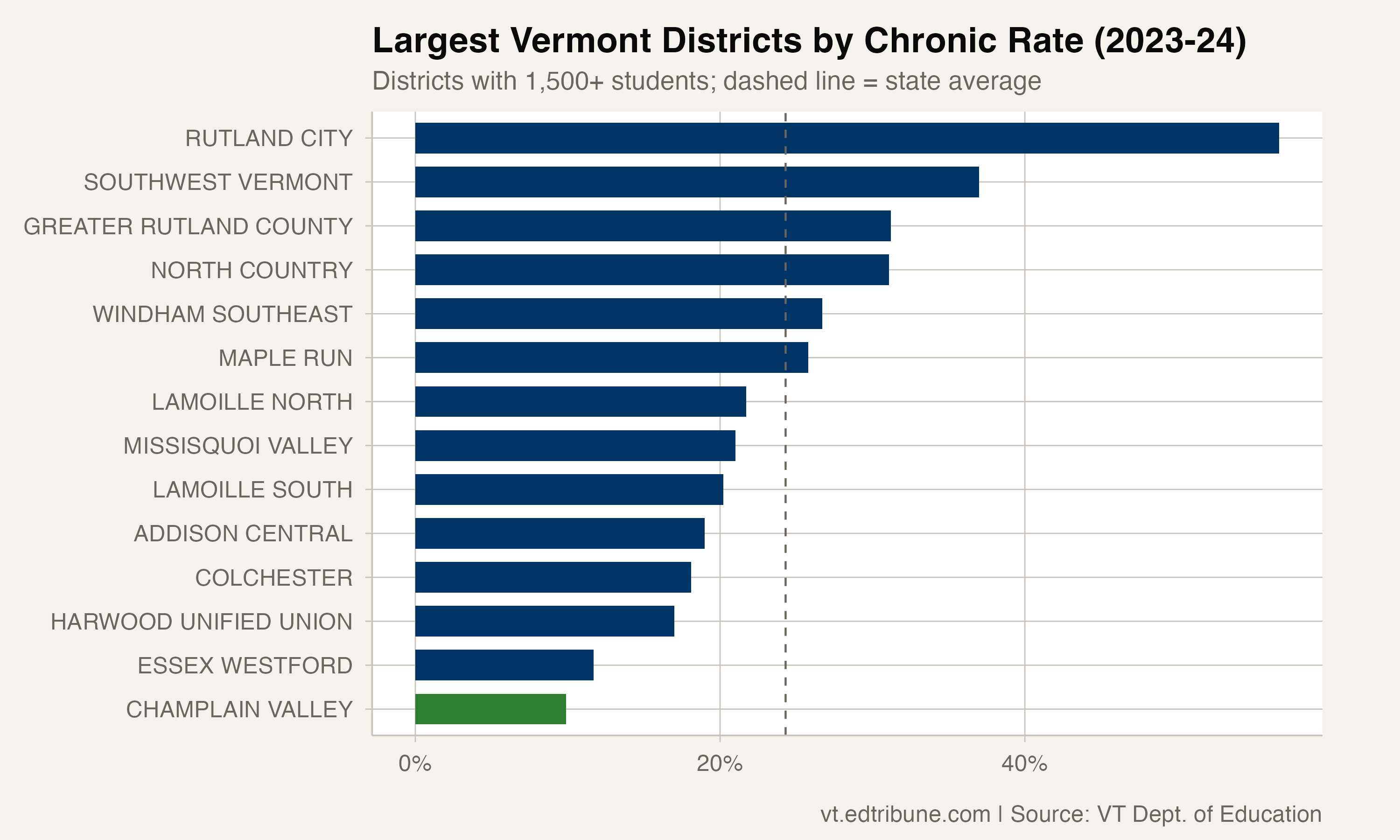
Among districts with 1,500 or more students, the next-closest rate belongs to Essex Westford SD↗ET at 11.7%. After that, the jump is steep: Colchester↗ET at 18.1%, Milton↗ET at 20.2%, and most others above 25%.
What the district did differently
CVSD's approach centered on something most districts do not systematically measure: whether students feel they belong. The district conducts student engagement surveys three times a year, tracking not just academic metrics but whether students feel their ideas are valued, whether they feel connected to adults in the building, and whether they see school as worth attending.
The data from those surveys produced a finding that guided the district's intervention strategy: students who feel their ideas are valued are chronically absent at half the rate of students who feel overlooked. That correlation does not prove causation — students with more stable home lives may both attend more regularly and report higher engagement. But it gave the district a lever to pull that was within its control.
Rather than focusing exclusively on the mechanics of attendance — phone calls, home visits, truancy proceedings — CVSD invested in the conditions that make attendance feel worthwhile. The engagement-first model treats chronic absenteeism as a symptom rather than a cause.
Context and caveats
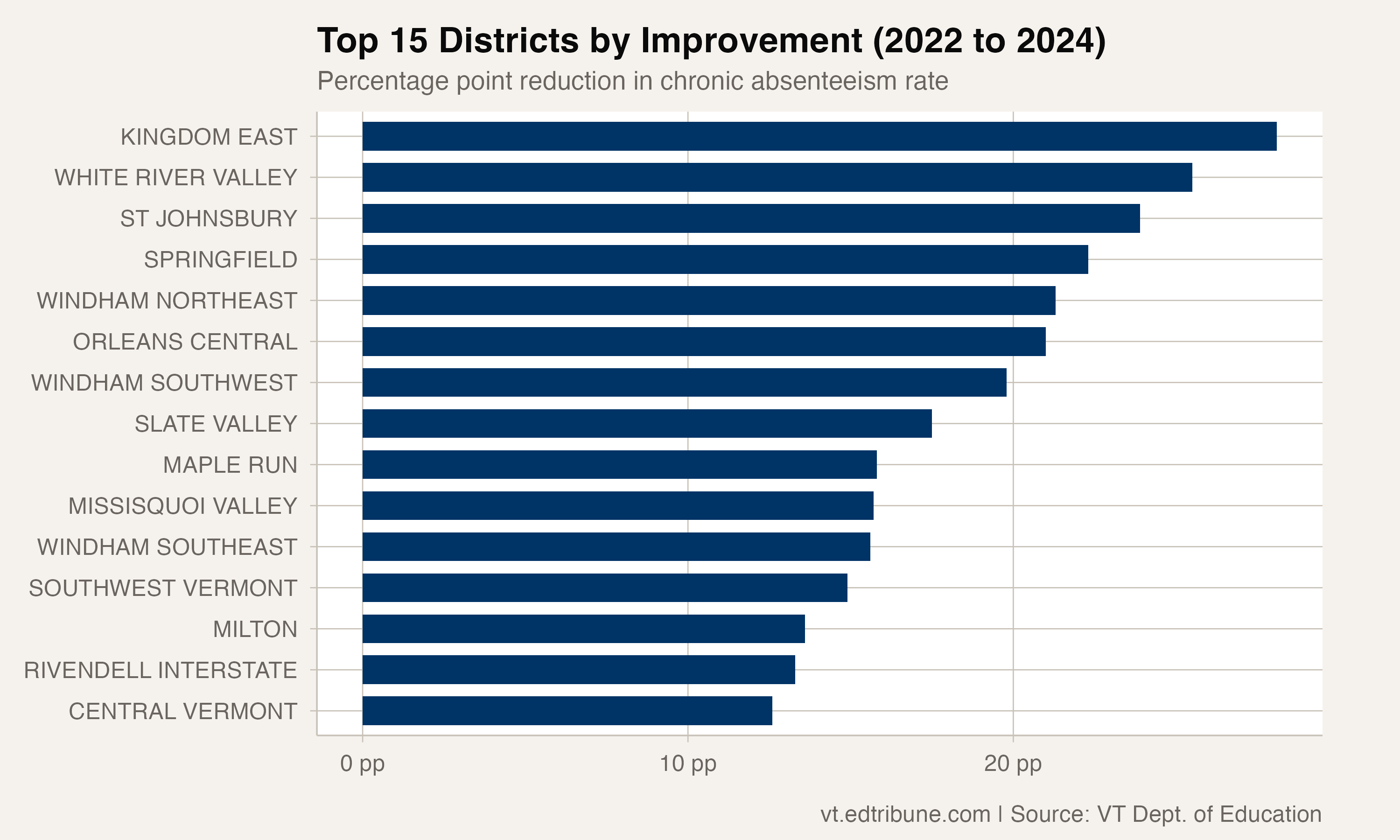
Champlain Valley's 11.4 percentage-point improvement ranks among the top performers in the state, though several smaller districts achieved larger drops. Kingdom East SD↗ET dropped 28.1 points, White River Valley fell 25.5, and Springfield cut 22.3 points. The difference is where they started: those districts came down from rates above 45%. Champlain Valley started below the state average and still cut its rate in half.
Geography matters. Champlain Valley sits in Chittenden County, Vermont's economic engine, with Burlington's labor market and the University of Vermont nearby. The district's families tend to have higher incomes and more stable employment than districts in the Rutland region or the Northeast Kingdom. An honest accounting of CVSD's success has to acknowledge that some portion of the improvement reflects community advantages that other districts cannot replicate through policy alone.
But the timeline matters too. CVSD's rate was 21.3% in 2022 — not vastly different from the state average. Whatever advantages the community provides, they did not prevent the COVID-era spike. The recovery required deliberate action. The question for other districts is not whether they can match CVSD's 9.9% — that may not be realistic everywhere — but whether the engagement-focused model works at all outside affluent suburban settings.
Detailed code that reproduces the analysis and figures in this article is available exclusively to EdTribune subscribers.
Discussion
Sign in to join the discussion.
Loading comments...