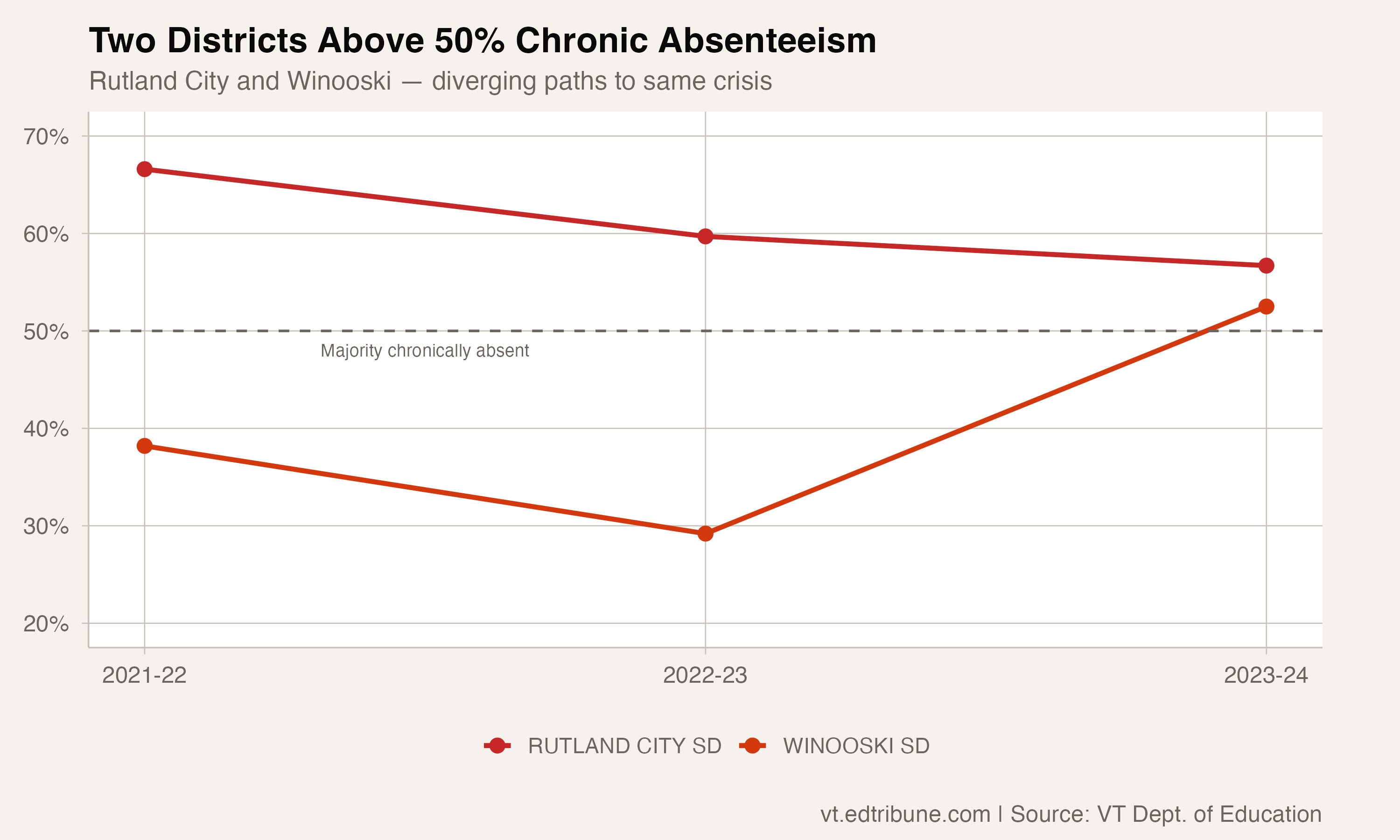
When more than half the students in a district are chronically absent, the word "chronic" stops describing a subpopulation and starts describing the norm. In Vermont in 2023-24, two districts crossed that threshold: Rutland City↗ET SD, where 56.7% of students missed at least 10% of school days, and Winooski↗ET SD, at 52.5%. They arrived at the same crisis from opposite directions.
Rutland City: improving, but from where
Rutland City has been above 50% for three consecutive years. At the 2021-22 peak, two-thirds of the district's students were chronically absent — 1,345 of 2,020 enrolled. The rate has fallen each year since: 66.6% to 59.7% to 56.7%. That trajectory represents genuine improvement, a nearly 10-point drop in two years.
But 56.7% means 1,095 of 1,931 students are still missing more than 18 days of school per year. The district is improving at a pace that, if sustained, would not bring it below the state average of 24.3% for another six years.
Rutland is a former railroad and marble city in the southern Green Mountains, the state's third-largest municipality. Like many small Vermont cities, it faces a convergence of economic pressures — manufacturing job losses, an aging population, and opioid addiction — that create compounding barriers to school attendance.
Winooski: the reversal
Winooski's trajectory is the more alarming of the two. The district's chronic rate had been falling: 38.2% in 2021-22, down to 29.2% in 2022-23. Then it reversed. In 2023-24, the rate surged to 52.5%, a 23.3 percentage point jump that dwarfs any other district in the state. Of 770 enrolled students, 404 were chronically absent.
Winooski is Vermont's most racially diverse district, where 57% of students are people of color and 33% receive multilingual services. The district became the first in Vermont to pass a sanctuary school policy in February 2025 after heightened immigration enforcement created documented anxiety among students and families. Teachers reported students afraid to come to school. The district's superintendent was detained by federal authorities, prompting a statement from the Vermont Agency of Education.
The 2023-24 data predates the sanctuary policy but captures the climate that prompted it. The data alone cannot prove that immigration enforcement drove the spike. But Winooski is the only district in Vermont whose chronic rate is higher now than it was at the pandemic peak, and the timing is hard to ignore.
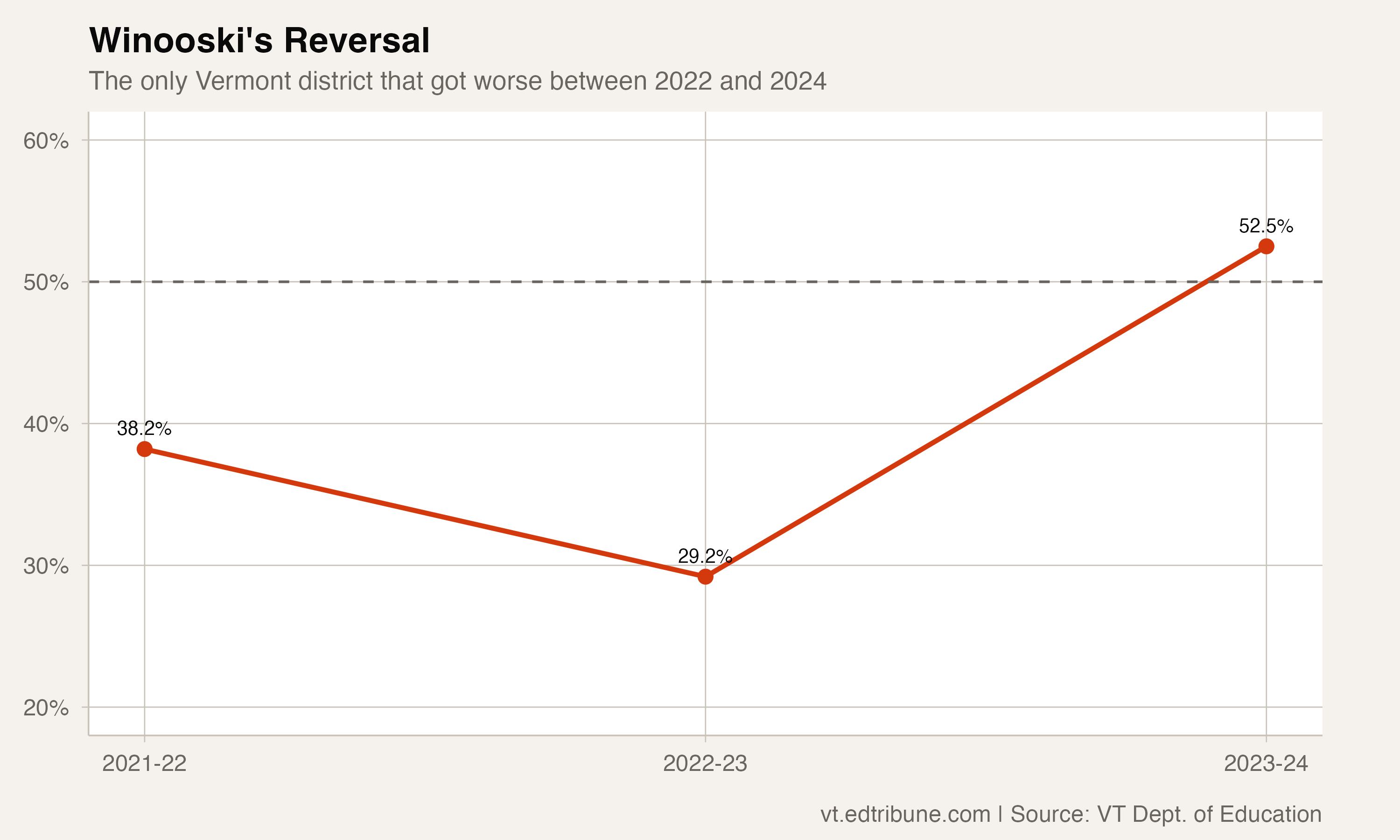
A rate that had fallen nine points in a single year reversed and nearly doubled. At 52.5%, Winooski's 2023-24 rate exceeds even the 2021-22 statewide peak year.
Where they stand
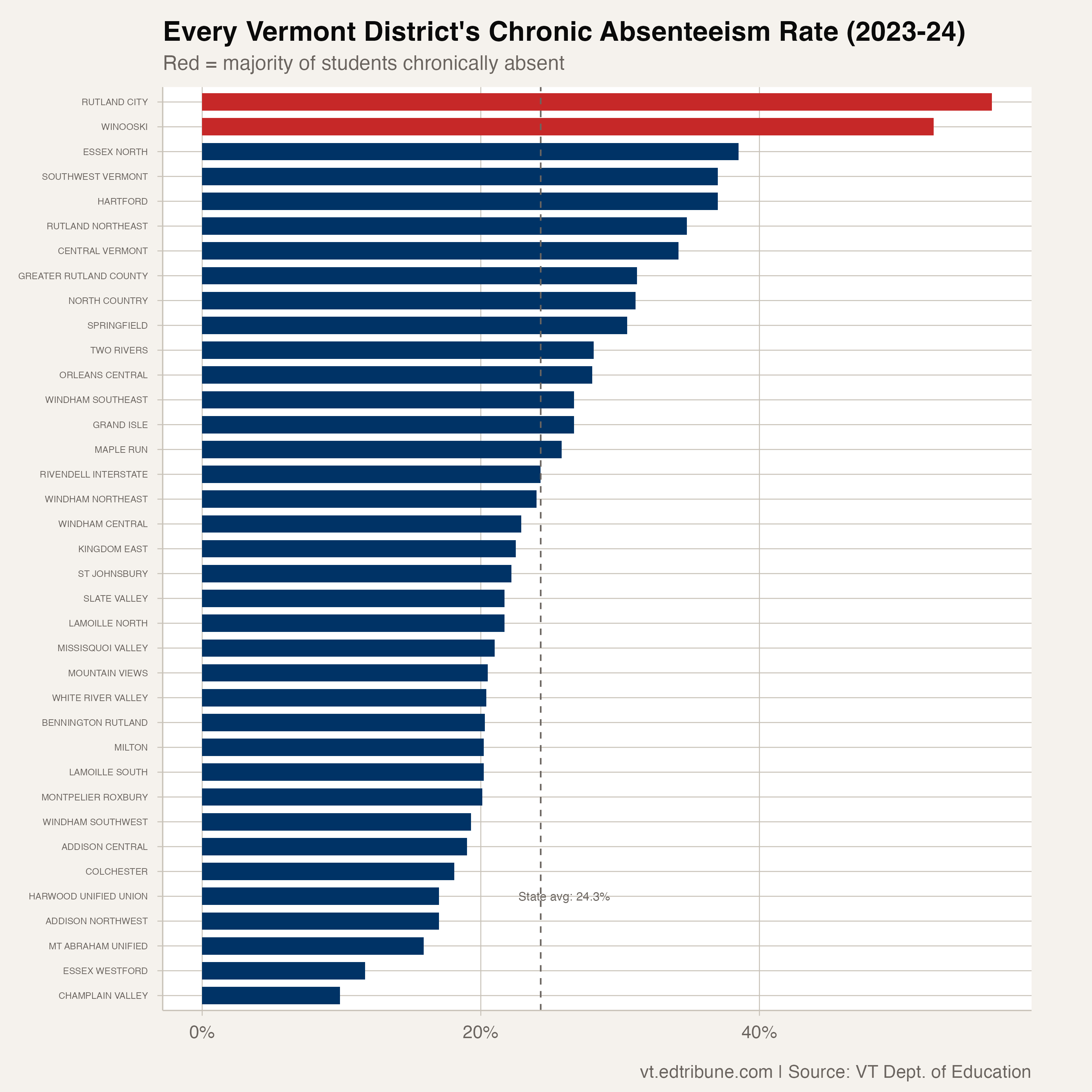
The gap between Vermont's highest and lowest chronic rates spans nearly 47 percentage points. Champlain Valley↗ET SD, the state's largest district 50 miles north in Chittenden County, sits at 9.9%. Rutland City, about half its size, is at 56.7%. Same state, same pandemic, same reporting methodology, a six-fold difference in outcomes.
Of 37 districts with reliable rate data, 10 are above 30% and 15 are above the state average. The concentration of high rates in the Rutland region — Rutland City at 56.7%, Rutland Northeast SU↗ET at 34.8%, Greater Rutland County SU↗ET at 31.2% — suggests geographic clustering that extends beyond any single district's leadership or policy choices.
The direction of travel
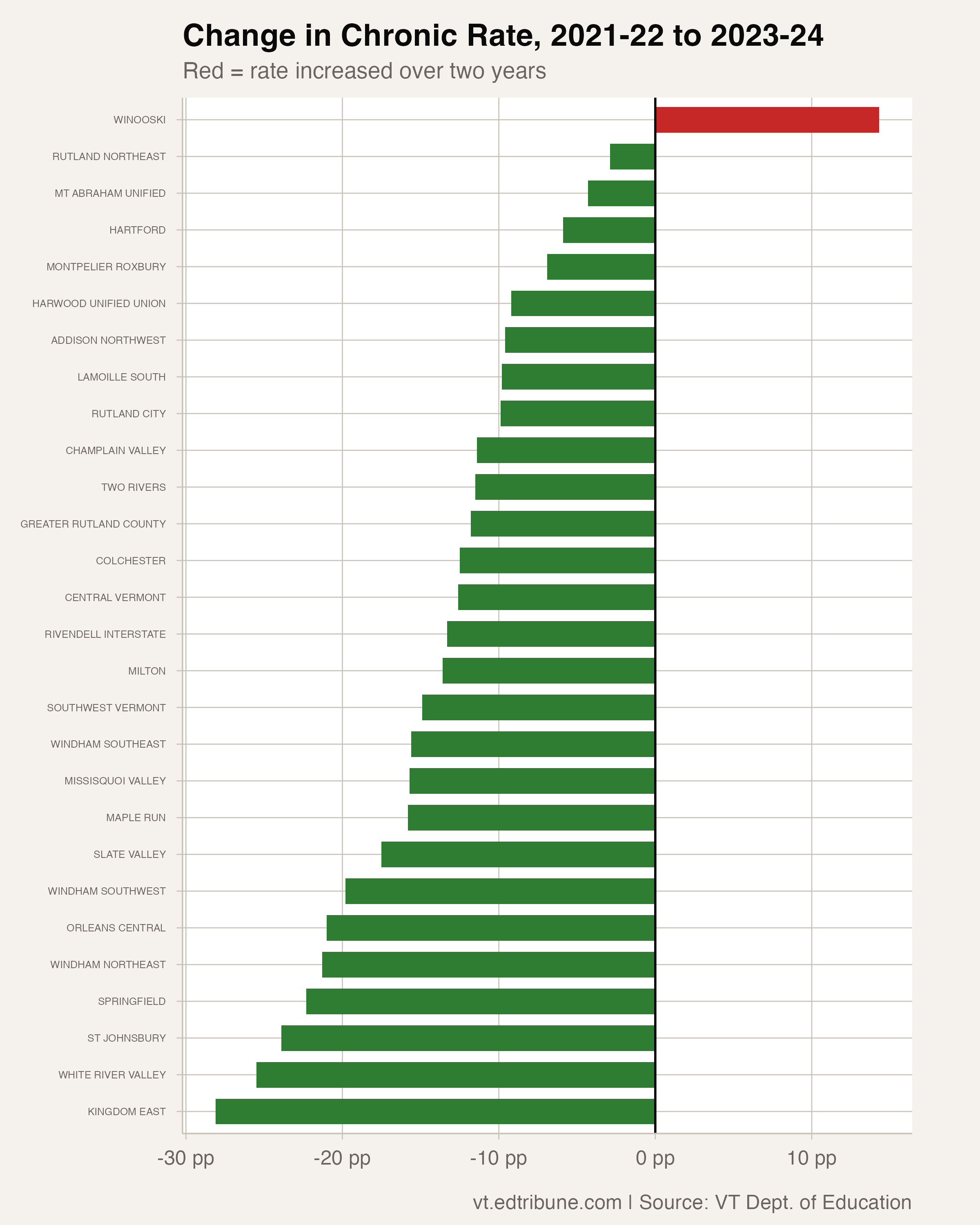
Across the state, the vast majority of districts improved between 2021-22 and 2023-24. Winooski is the only district where the chronic rate is higher now than it was at the statewide peak. Hartford↗ET SD and a small number of others saw year-over-year increases in 2024, but their two-year trajectory still shows net improvement.
Rutland City, at its current pace, will still have a majority of students chronically absent next year. Winooski needs to reverse a one-year surge that coincided with forces largely outside a school district's control. Both are small enough that a superintendent can name the families. Neither is small enough that naming them has been sufficient.
Detailed code that reproduces the analysis and figures in this article is available exclusively to EdTribune subscribers.
Discussion
Sign in to join the discussion.
Loading comments...