Correction: An earlier preview treated the change in an aggregate count as if it tracked specific students, described an unverified intervention pattern, and compared Addison Central with an undefined statewide group. This version removes those claims and states the reporting coverage behind each comparison.
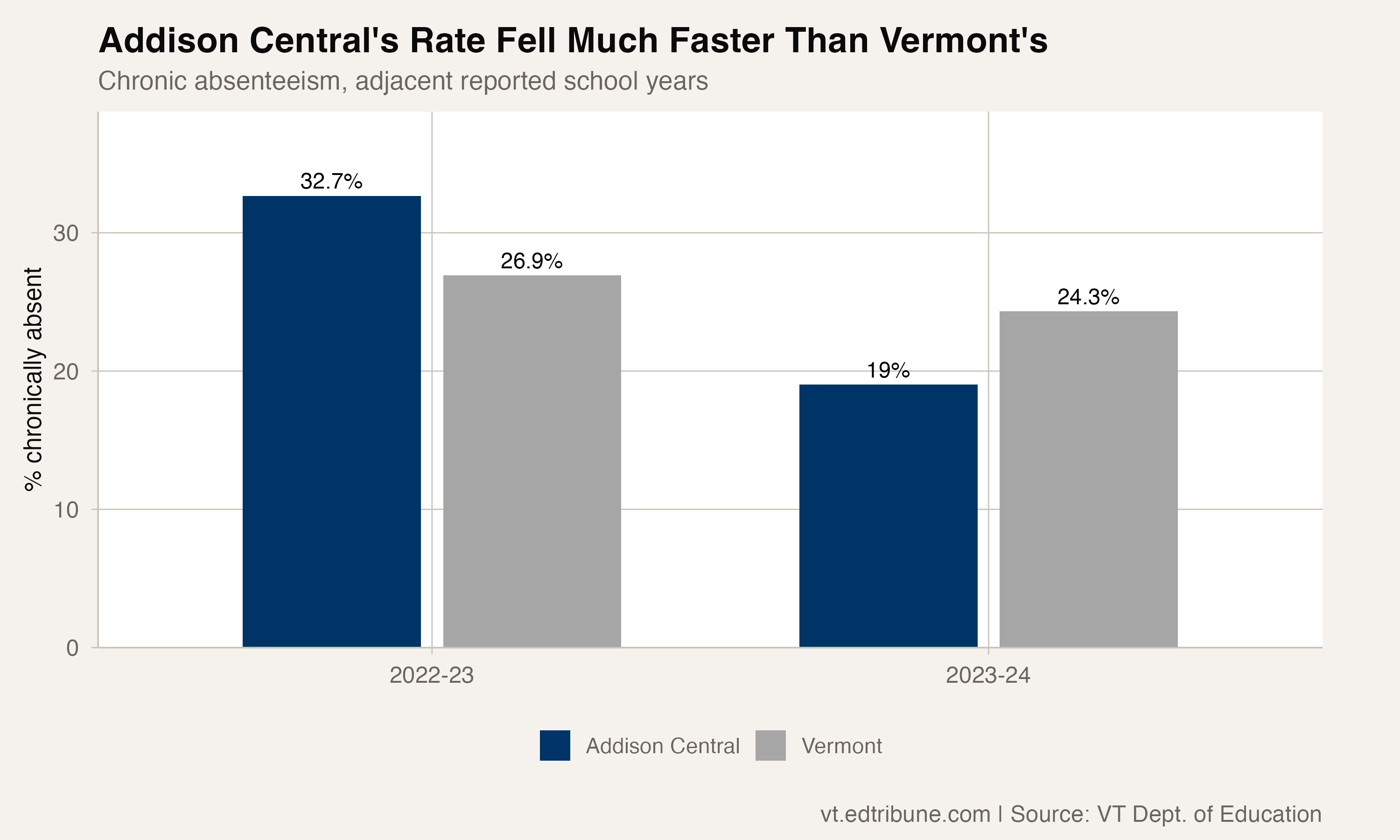
Addison Central School District↗ET recorded 580 chronically absent students among an enrollment denominator of 1,775 in 2022-23. In 2023-24, the state files recorded 334 among 1,757. Those counts produce rates of 32.7% and 19.0%, respectively: a 13.7-percentage-point decline.
That was the largest decline among 33 Vermont district IDs with usable chronic-absence counts and enrollment denominators in both years. The recorded chronic-absence count was 246 lower.
A first-place decline in a limited panel
The comparison is built on stable state district IDs, not district names. Addison Central ranked first using a tie-aware minimum rank, and no other reporting district had the same decline.
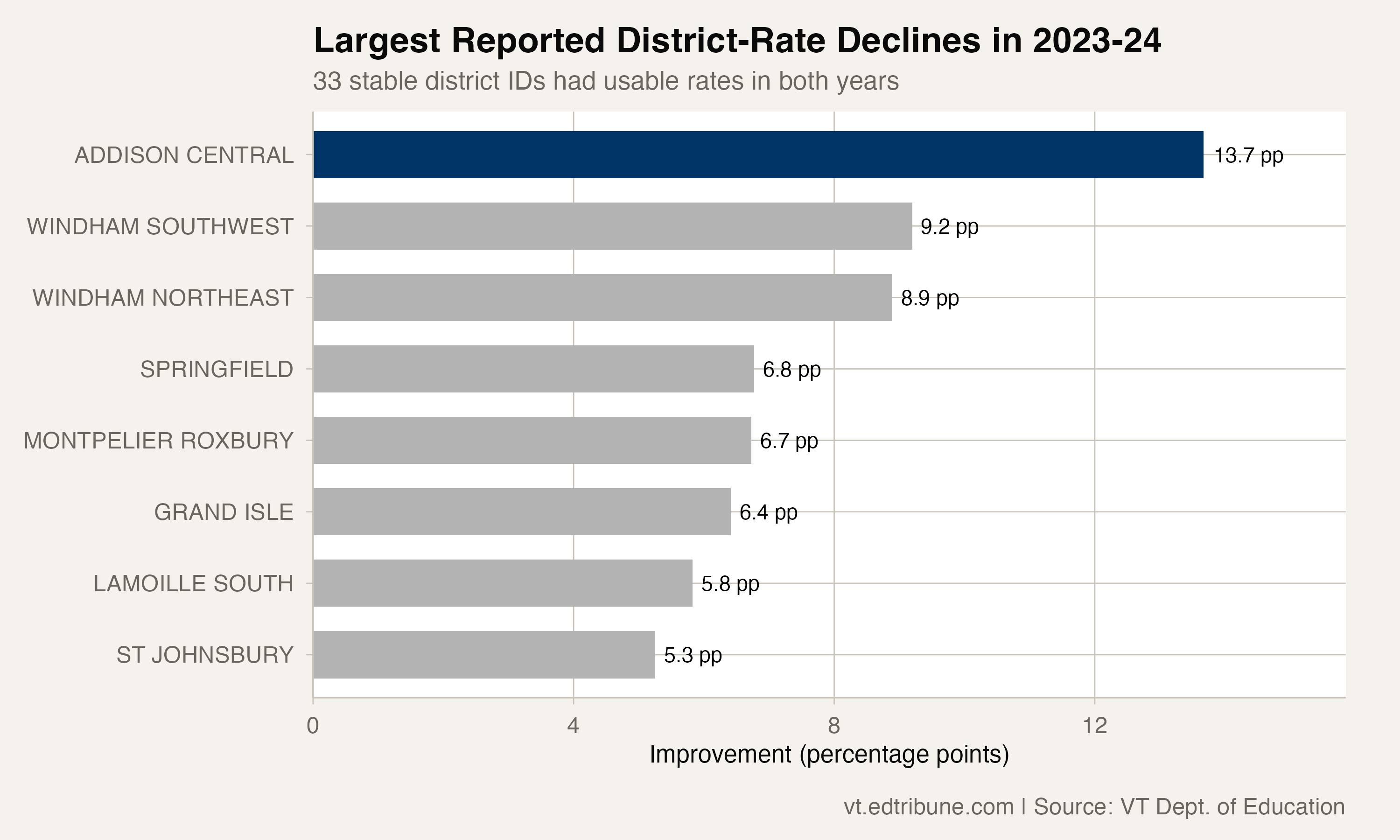
That rank needs a coverage qualifier. The 2023-24 source contains 52 district-level rows, but only 37 have both a usable chronic-absence count and enrollment denominator. Requiring usable rates in both years leaves 33 district IDs. Suppressed or missing values are excluded rather than converted to zeros.
What the 246-student difference means
The aggregate files support a count comparison, not a student-level transition claim. They show 246 fewer students classified as chronically absent in 2023-24 than in 2022-23. They do not identify which students entered or left the district, changed attendance status, or moved between schools.
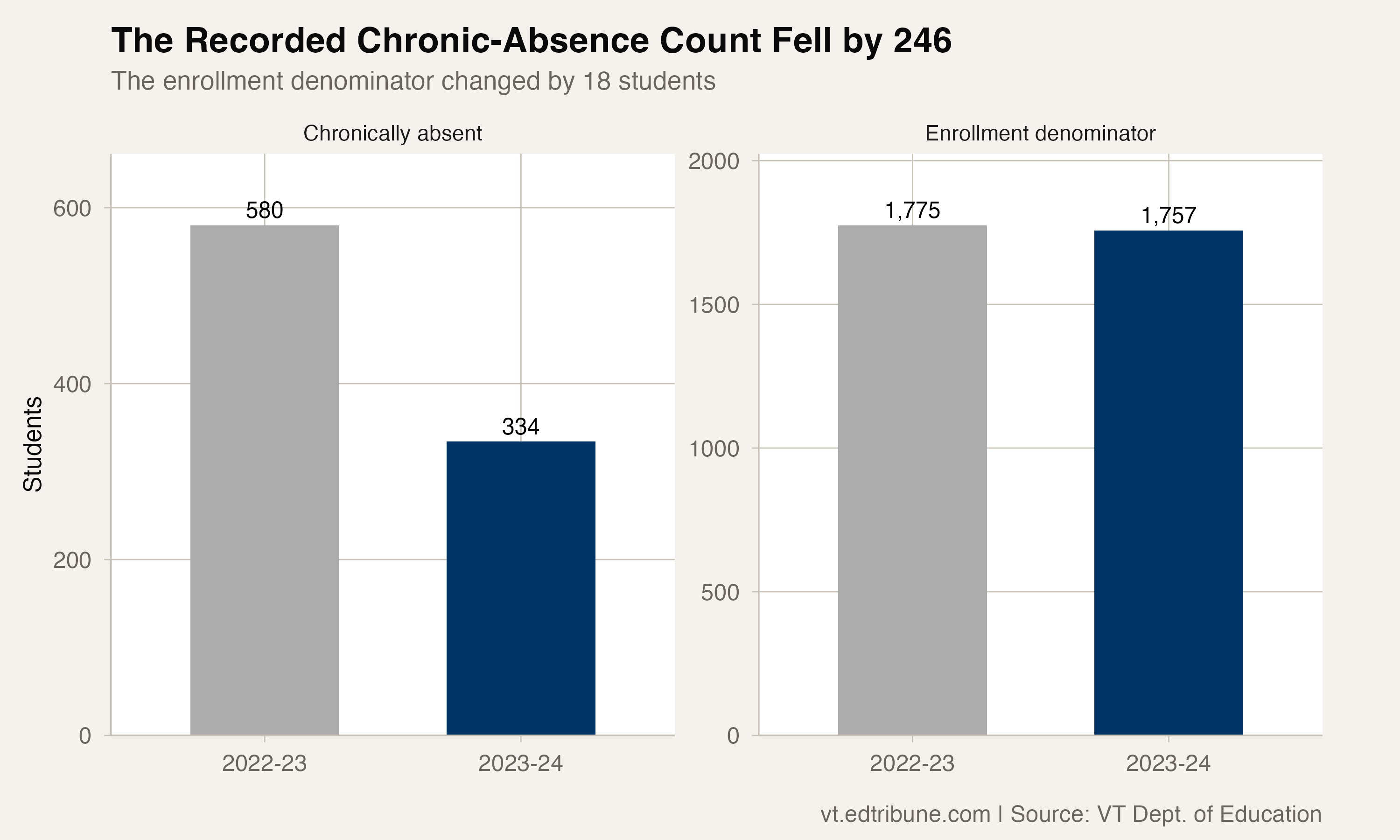
The denominator check matters because rates can move when the population being measured changes. Here, the denominator changed little compared with the numerator. The arithmetic reconciles to the published rates after rounding, but it does not establish why the count changed.
The longer panel is not a continuous recovery test
The source labels change across files: the absence records use "Addison Central SD," while enrollment records also use "Addison Central SU" and "Addison Central Supervisory District." Joining on the stable ID avoids treating those label changes as different systems.
The package has no usable Addison Central rate for 2021-22 because the chronic-absence count is missing. This article therefore does not draw a continuous recovery trend across the longer panel. Its finding is limited to the directly comparable 2022-23 and 2023-24 records.
What the files cannot explain
Unresourced: The statewide files do not identify a program, staffing decision, policy change, transportation improvement, or other local action that produced Addison Central's decline. No causal explanation is assigned here.
Competing explanation: Changes in reporting practice, classification, student composition, or the population covered by the district total could affect the measured rate. Aggregate counts cannot separate those possibilities from the effect of district attendance work.
The defensible finding is narrower and still substantial: among Vermont district IDs with comparable reported data, Addison Central recorded the largest 2023-24 decline in chronic absenteeism.
The VTEdTribune contacted Addison Central Superintendent Wendy Baker for comment and did not receive a response before publication.
The analysis uses chronic-absence and enrollment records from the Vermont Agency of Education's Vermont Education Dashboard data downloads. Rates are calculated from the all-students chronic-absence count and the corresponding total-enrollment denominator exposed by the state-data package.
Detailed code that reproduces the analysis and figures in this article is available exclusively to EdTribune subscribers.
Discussion
Sign in to join the discussion.
Loading comments...