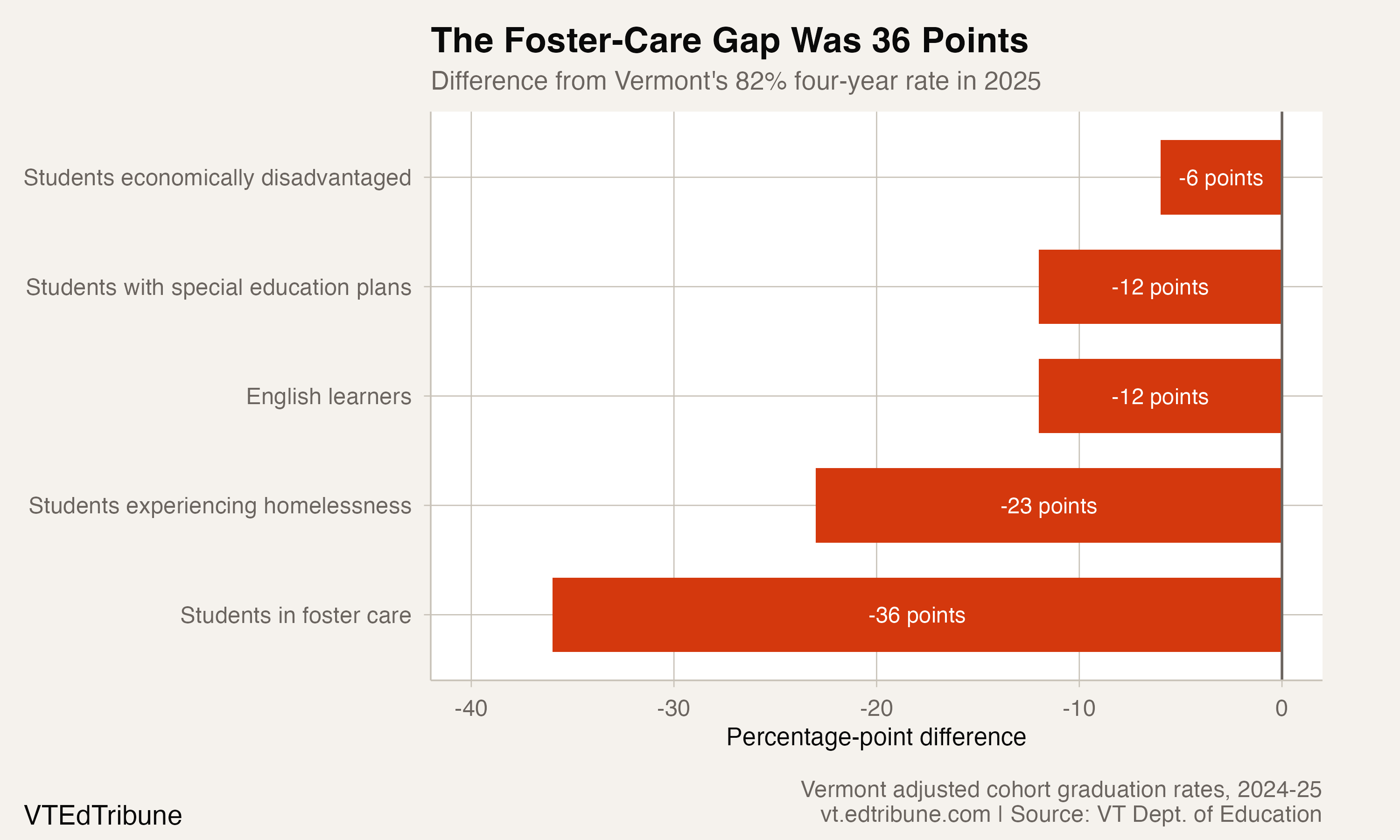
Vermont's four-year graduation rate for students in foster care was 46% in 2025. The statewide rate was 82%, leaving a 36-point gap in the state's newest subgroup results.
The foster-care result was the lowest among 21 state subgroups with published four-year rates. It represented a cohort of 95 students. Students who were experiencing homelessness had the next-lowest rate, 59%, in a cohort of 236.
Circumstance marked the widest gaps
The comparison does not rank individual schools or districts. Vermont's public file reports these subgroup results only at the state level, and only for the 2025 cohort. It nevertheless shows that the largest gaps in the available snapshot were tied to students' circumstances.
The 59% rate for students who were experiencing homelessness was 23 points below the state. Students with special education plans and English learners each had a 70% four-year rate. Students who were economically disadvantaged had a 76% rate.
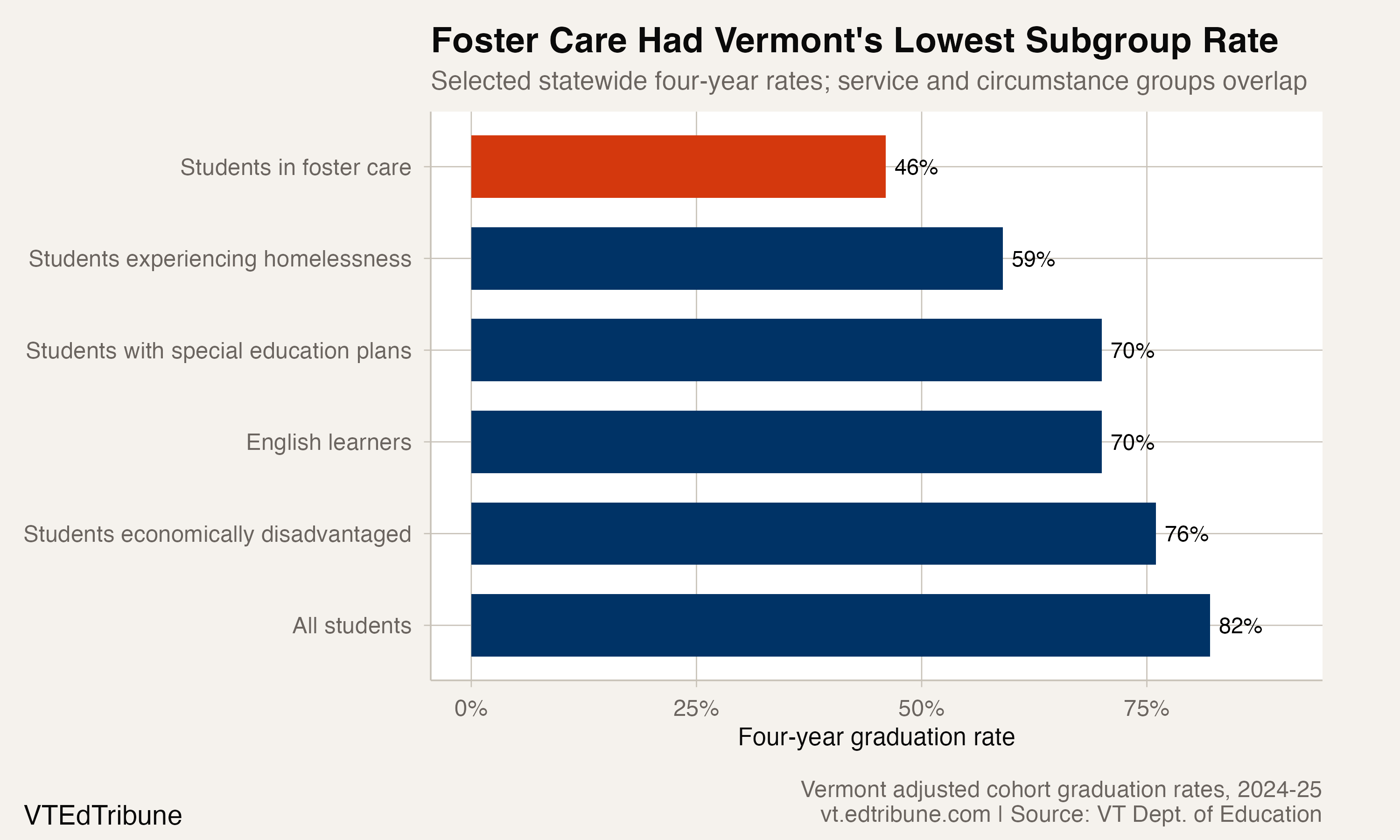
Those categories overlap. A student may appear in more than one service or circumstance group, so their rates should not be added together or treated as pieces of a single population.
Extra time did not lift the published foster-care rate
Vermont also reports a six-year graduation measure. For students in foster care, that published rate was again 46%. By comparison, the all-student rate rose from 82% at four years to 84% at six years.
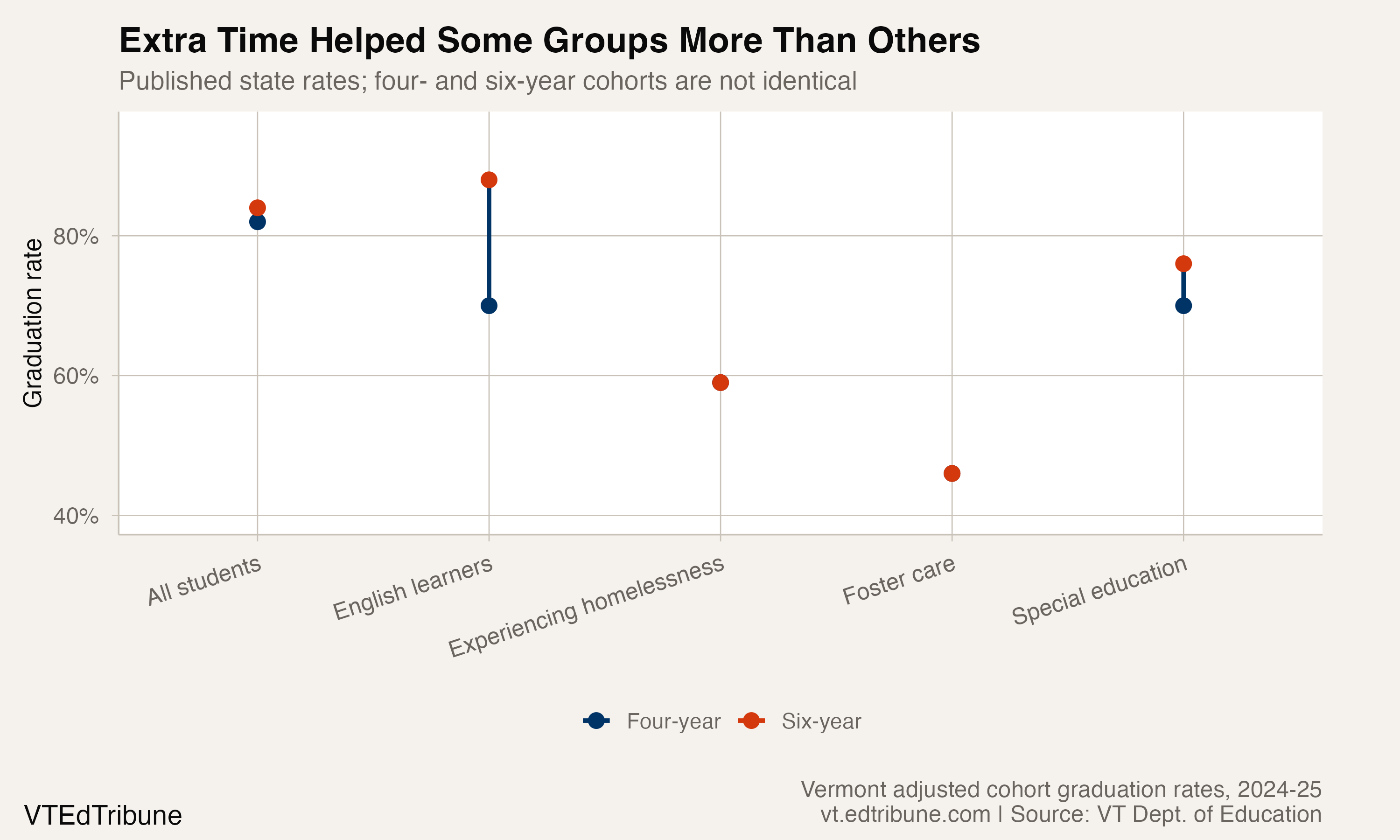
The four- and six-year measures do not follow one identical cohort in this file. The foster-care four-year cohort had 95 students, while the six-year cohort had 113. The matching rates therefore show two published outcomes, not proof that no individual student completed a diploma after the four-year mark.
That distinction matters because the aggregate data cannot identify placement changes, school moves, interrupted services or any other mechanism behind the gap. It can locate the disparity. It cannot explain why it occurred.
A small cohort with a large statewide consequence
The foster-care cohort was small relative to the statewide group, which makes its rate more sensitive to the outcome of each student. The result is still a statewide measure, not a sample. In the published comparison, it sat 36 points below the state and 13 points below the rate for students who were experiencing homelessness.
The next reporting cycle will show whether the 2025 result was a one-cohort low or part of a persistent pattern. Vermont's current public subgroup series does not yet provide the history needed to make that trend claim.
Data source: Vermont Agency of Education four- and six-year adjusted cohort graduation results for 2025. The agency explains how to obtain the official files on its Annual Snapshot data-download page.
Detailed code that reproduces the analysis and figures in this article is available exclusively to EdTribune subscribers.
Discussion
Sign in to join the discussion.
Loading comments...